

 By
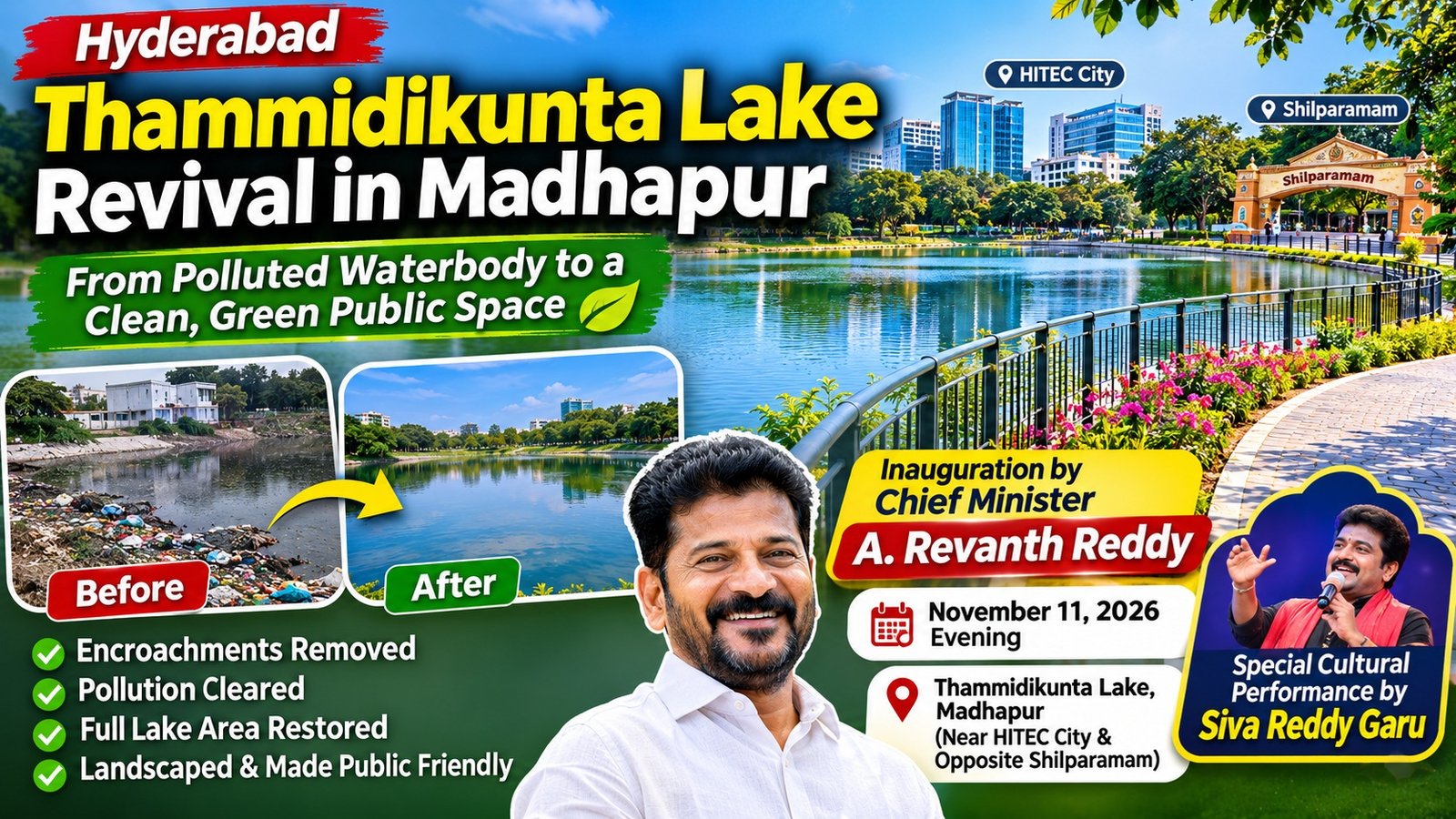
Thammidikunta Lake in Madhapur stands as one of Hyderabad’s most dramatic environmental turnarounds. Once reduced to a polluted, shrinking water body hemmed in by illegal structures, the lake has reclaimed its original footprint and transformed into a clean, accessible public space. Chief Minister A. Revanth Reddy prepares to inaugurate the fully restored lake on the evening of November 11, 2026, at the site near HITEC City and opposite Shilparamam. A special cultural performance by Siva Reddy Garu will mark the celebration, turning the event into both an official dedication and a community gathering under the banner of a beautiful lake, a grand celebration and a greener tomorrow.
This revival did not happen overnight. It required determined action against powerful encroachments, massive physical cleanup, engineering improvements and sustained political will. The story of Thammidikunta Lake offers a clear window into Hyderabad’s wider struggle to protect its water bodies in the face of rapid urban growth.
Historical Roots of Thammidikunta Lake in Madhapur and Khanamet
Thammidikunta Lake, also spelled Tammidikunta or Thammidi Kunta, has existed in the Madhapur-Khanamet area for centuries. Local accounts trace its presence to the Nizam period, when the region consisted of agricultural fields, rocky outcrops and interconnected water bodies rather than the gleaming IT campuses that define it today. Residents relied on the lake for irrigation, fishing and domestic water needs. Freshwater wells around the lake, including the well-known Mota Bavi, supplemented drinking supplies for nearby villages.
The name itself carries local memory. According to older residents, dense stands of Tammidi bushes and trees once surrounded the water body. Over time the landscape feature gave the lake its name—Thammidikunta. For generations the lake formed part of the cultural and economic life of Khanamet. Farmers drew water for crops, families gathered along its banks, and the water body helped regulate the natural drainage of the surrounding low-lying areas.
By the late twentieth century the picture began to change. Hyderabad’s expansion, especially the explosive growth of the IT corridor around Madhapur, HITEC City and Cyberabad, placed intense pressure on open spaces and water bodies. Agricultural land converted into residential colonies, commercial plots and institutional campuses. Lakes that had once served clear ecological and community functions found themselves squeezed by development. Thammidikunta was no exception.
Surveys conducted in the mid-2010s already recorded the lake’s Full Tank Level area at roughly 29 to 30 acres, including buffer zones. Even then, officials noted that structures had begun to push into the protected boundaries. The lake’s role in absorbing monsoon runoff and recharging groundwater remained critical, yet the surrounding urban fabric increasingly ignored those functions.
How Encroachments and Pollution Nearly Destroyed Thammidikunta Lake
Over the years Thammidikunta Lake shrank dramatically. Encroachments reduced its effective water spread from approximately 30 acres to as little as 14 acres. Illegal structures, raised ground levels and boundary walls cut into the Full Tank Level and buffer zones. Sewage from nearby colonies and commercial establishments flowed directly into the water. Plastic waste, construction debris and even biomedical refuse accumulated on the lake bed and along the banks.
The consequences were visible and unpleasant. Foul odours spread through neighbouring areas. Mosquito breeding intensified. During heavy rains the reduced capacity of the lake contributed to waterlogging around Shilparamam and nearby roads. What had once been a functional water body turned into a neglected dumping ground that residents preferred to avoid.
One of the most prominent structures associated with the lake was the N-Convention Centre. The large event venue, managed by N3 Enterprises and linked to actor Akkineni Nagarjuna, occupied a significant parcel on the eastern side of the lake. Official assessments later determined that portions of the property, amounting to roughly 1.12 acres within the Full Tank Level and additional area in the buffer zone, constituted encroachment. The raised platforms and retaining walls effectively reduced the lake’s water-holding capacity and obstructed natural flow paths.
For years the issue lingered. Notices were issued, surveys conducted and court proceedings initiated, yet the structure remained. The situation illustrated a broader pattern in Hyderabad: high-value land around lakes often attracted powerful interests, while enforcement lagged.
HYDRAA’s Landmark Demolition of N-Convention Centre in August 2024
The turning point arrived on 24 August 2024. The newly formed Hyderabad Disaster Response and Asset Protection Agency, known as HYDRAA, moved decisively. Early that morning enforcement teams arrived with heavy machinery and police support. They demolished the portions of the N-Convention Centre identified as lying within the protected lake boundaries.
The action generated immediate controversy. Actor Nagarjuna described the demolition as unlawful and based on misinformation. He stated that the land was patta land and that court proceedings were pending. Supporters of the action countered that official maps, earlier surveys and complaints from elected representatives clearly established the encroachment. HYDRAA officials emphasised that the agency’s mandate included protecting water bodies and reclaiming public assets, regardless of the identity of the occupant.
The demolition removed a major physical barrier. It also sent a strong public signal that lake protection would no longer remain a paper exercise. Subsequent inspections identified additional illegal occupations around the lake. HYDRAA systematically cleared these structures, reclaiming nearly 15 to 16 acres of prime land in one of Hyderabad’s most expensive localities. Estimates placed the market value of the recovered public asset at well over Rs 1,200 crore, and in some assessments significantly higher given prevailing rates of several lakhs per square yard in Madhapur.
Comprehensive Restoration Drive by HYDRAA Transforms Thammidikunta Lake
With the encroachments cleared, HYDRAA launched a full-scale restoration programme. Teams removed vast quantities of accumulated silt, plastic, construction debris and organic waste. Desilting operations reached depths of up to 15 feet in places. Thousands of truckloads of material left the site. According to official figures associated with the project, the effort involved approximately 35,000 truckloads of waste and debris in total.
Engineers strengthened the lake bunds, rebuilt and upgraded inlets and outlets, and installed pipelines to divert sewage away from the water body. Three inlet pipes now channel rainwater from surrounding roads and drains directly into the lake. An outlet system manages excess water safely. These changes address the long-standing waterlogging problems near Shilparamam and improve linkages to downstream water bodies such as Mundla Kathwa.
The water storage capacity of the lake has increased dramatically. From an earlier figure of around 46 million litres, the restored water body can now hold approximately 375 million litres when full. The expanded surface area of roughly 30 to 30.5 acres, combined with greater depth after desilting, accounts for this substantial gain. Improved catchment drainage ensures that monsoon runoff reaches the lake rather than flooding nearby streets.
Creating Public Amenities and a Green Recreational Space
Restoration went beyond cleaning and engineering. HYDRAA developed the surroundings into a people-friendly zone. A walking track measuring approximately 1.2 to 2 kilometres now circles the lake. Officials planted trees along the bund for shade and improved air quality. They added open gyms, children’s play areas, seating for the elderly, yoga zones, gazebos and a rose garden. Fencing secures the perimeter while pathways improve access. The main entrance near Shilparamam has been redesigned for better visibility and convenience.
These amenities turn the restored lake into more than a water storage facility. It becomes a recreational asset for residents of Madhapur, HITEC City professionals, families and evening walkers. What was once an area people avoided has begun attracting people seeking open space, exercise and calm in the middle of a dense urban corridor.
The project forms part of HYDRAA’s first phase of lake rejuvenation, which covers six water bodies across Hyderabad. Thammidikunta, together with Sunnam Cheruvu nearby, received particular attention because of their location in the IT corridor and their history of severe encroachment. The agency has emphasised that restored lakes should serve dual purposes: ecological protection and public recreation.
Environmental and Flood-Management Benefits of the Revived Lake
Urban lakes in Hyderabad perform critical functions that concrete infrastructure cannot fully replace. They absorb excess rainfall, reduce flood peaks, recharge groundwater and support local microclimates. When lakes shrink or fill with silt and sewage, these services collapse. Waterlogging increases, groundwater levels fall and urban heat intensifies.
Thammidikunta’s restoration directly addresses these issues. The larger water surface and improved inlets allow the lake to capture more stormwater. The diversion of sewage reduces pollution loads that once degraded water quality and produced foul smells. Desilting restores depth and storage volume. The linked drainage network helps move water safely through the chain of water bodies in the Madhapur area.
Residents have already noticed practical improvements. Areas around Shilparamam that regularly flooded during rains now benefit from better inflows into the lake. The removal of waste and the presence of cleaner water and greenery have reduced the mosquito nuisance and improved the overall environment. As more rainwater enters the restored system, groundwater recharge is expected to strengthen over successive monsoons.
The Grand Inauguration of Thammidikunta Lake on 11 November 2026
Tomorrow evening, 11 November 2026, Chief Minister A. Revanth Reddy will formally inaugurate the restored Thammidikunta Lake. The event takes place at the lake itself in HITEC City, Madhapur. Organisers have arranged a special artistic performance by Siva Reddy Garu. The programme emphasises celebration of the revived water body and the broader vision of a greener, more liveable Hyderabad.
The inauguration marks the public culmination of more than two years of sustained work that began with the high-profile demolition in August 2024. It also signals the government’s continued focus on lake protection as a priority. HYDRAA Commissioner A.V. Ranganath and local officials have repeatedly inspected the site, directed finishing works on pathways, landscaping and amenities, and coordinated with municipal teams to ensure the lake is ready for public use.
Visitors can expect a transformed landscape: a clean water body of approximately 30.5 acres, strengthened embankments, functional stormwater systems, walking tracks, green spaces and recreational facilities. The contrast with the polluted, constricted lake of previous years will be unmistakable.
Wider Lessons from the Thammidikunta Lake Revival
The story of Thammidikunta Lake illustrates both the scale of the challenge and the possibility of recovery. Encroachments on water bodies do not merely reduce open space; they undermine the city’s natural flood defences and long-term water security. High-value locations such as Madhapur make the pressures especially intense. When enforcement agencies act consistently, however, significant public land and ecological capacity can be recovered.
HYDRAA’s approach—combining legal action against encroachments, large-scale physical cleanup, engineering upgrades and the creation of public amenities—offers a replicable model. Other lakes in the first phase and subsequent phases can follow similar paths. Success will depend on continued maintenance, prevention of fresh encroachments and community stewardship once the lakes are opened.
For residents of Madhapur and the wider Hyderabad metropolitan area, the restored lake provides an immediate quality-of-life improvement. It offers a place to walk, exercise, sit and experience open water and greenery without travelling far from home or work. In a city where green and blue spaces have steadily diminished, each successfully revived lake represents a meaningful gain.
Looking Ahead: Sustaining the Gains at Thammidikunta Lake
Inauguration is a milestone, not an endpoint. Long-term success requires ongoing vigilance. Sewage diversion systems must function reliably. Solid waste must not re-enter the water body. The walking tracks, parks and gyms need regular maintenance. Catchment areas should remain free of new dumping. Monitoring of water quality and ecological health will help track progress.
Community involvement can strengthen these efforts. Local residents who once complained about foul smells and flooding now have a stake in protecting the revived asset. Schools, resident welfare associations and corporate campuses in the IT corridor can adopt stretches of the lake for cleanliness drives or tree care. Transparent public reporting of water levels, quality parameters and maintenance schedules can build trust and accountability.
Thammidikunta Lake’s journey from a shrinking, polluted remnant to a 30.5-acre restored water body with dramatically increased storage capacity demonstrates what determined action can achieve. The removal of 35,000 truckloads of waste, the reclamation of valuable public land, the engineering of proper inlets and outlets, and the creation of inviting public spaces have rewritten the lake’s recent history.
On the evening of 11 November 2026, when Chief Minister Revanth Reddy dedicates the lake in the presence of citizens and a cultural performance by Siva Reddy Garu, Hyderabad will celebrate more than a cleaned-up water body. It will mark the recovery of a natural asset that serves both ecological necessity and human well-being in one of the city’s most dynamic neighbourhoods. The restored Thammidikunta Lake stands as tangible evidence that urban growth and environmental protection need not remain permanent opposites. With continued care, the lake can continue to expand its contribution to a greener, more resilient Hyderabad for years to come.
