
 By
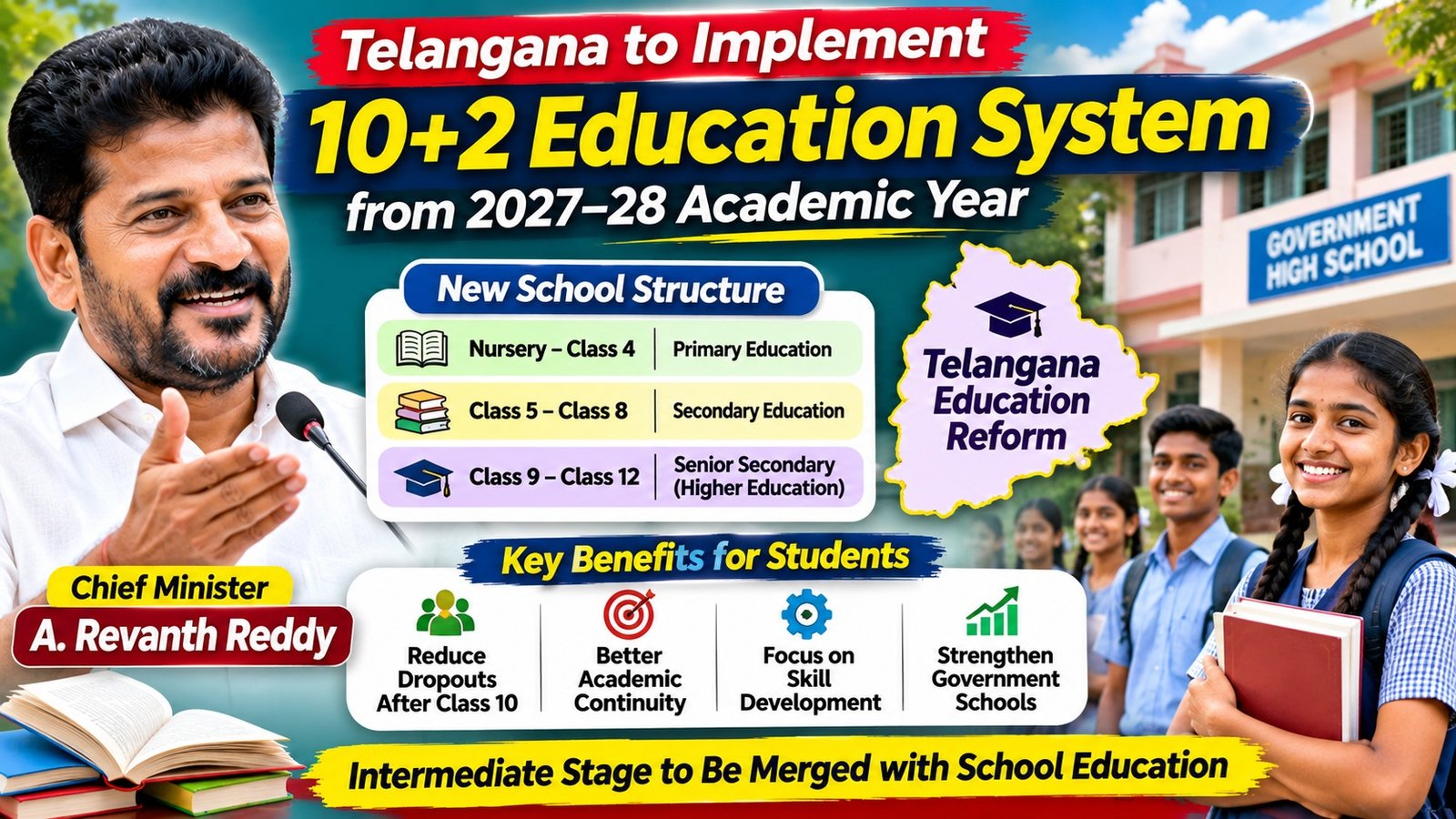
Telangana stands on the brink of a major transformation in its school education structure. Chief Minister A. Revanth Reddy has directed officials to implement a full 10+2 education system from the 2027-28 academic year. This change will merge the existing Intermediate stage with regular school education, bringing Classes 11 and 12 under the school system in line with the model followed by CBSE, ICSE and most other Indian states.
The announcement came during a high-level review meeting held on 11 November 2026 at the Dr. Marri Chenna Reddy Human Resource Development Institute (MCRHRDI) in Hyderabad. Senior education department officials, Chief Secretary Sanjay Jaju and government adviser K. Keshava Rao attended the discussion. Revanth Reddy, who also holds the education portfolio, stressed the need for reforms that match modern requirements while protecting student interests.
Under the new framework, education will follow a clear progression: nursery to Class 4 as primary, Classes 5 to 8 as secondary, and Classes 9 to 12 as senior secondary or higher education. Officials will provide specialised teaching during the Class 9 to 12 years. The government will also place stronger emphasis on skill development after Class 12. This move effectively ends the separate Intermediate system that currently operates through junior colleges under the Telangana State Board of Intermediate Education.
The decision builds on earlier recommendations from the Telangana Education Commission. It aims to reduce the high number of students who leave education after Class 10, improve continuity, and raise the quality of government schools closer to private institutions. Implementation will require significant planning, infrastructure upgrades and stakeholder consultations, but the timeline is now firmly set for the 2027-28 academic year.
Why Telangana Is Ending the Separate Intermediate System
For decades, Telangana (and earlier Andhra Pradesh) maintained a distinct Intermediate stage after Class 10. Students completing SSC moved to junior colleges for two years of specialised study in streams such as MPC, BiPC, CEC or MEC. This structure created a clear break between school and the pre-university phase.
While the system produced strong results in competitive examinations for many students, it also generated problems. A significant percentage of students, particularly from government schools, rural areas, girls and marginalised communities, dropped out after Class 10 rather than joining separate junior colleges. Distance, cost, lack of familiar teachers and social barriers contributed to this gap. Data and observations repeatedly highlighted that institutions offering continuous education up to Class 12, such as Kendriya Vidyalayas, Navodaya Vidyalayas and Kasturba Gandhi Balika Vidyalayas, recorded far lower dropout rates.
Revanth Reddy and officials noted that around 18 states already follow the integrated 10+2 model. Aligning Telangana with this national pattern supports smoother transitions for students seeking higher education or competitive exams under common frameworks. The National Education Policy also encourages a unified school structure that reduces fragmentation.
The Chief Minister emphasised that the government prioritises education from nursery through Class 12. He directed officials to treat Classes 9 to 12 as a specialised higher education phase and to develop the required infrastructure. The reforms form part of a broader effort to strengthen government schools through better facilities, updated syllabi, Young India Integrated Residential Schools and Telangana Public Schools that offer continuous education from pre-primary to Class 12.
Key Features of the Proposed 10+2 Education System in Telangana
The new system will integrate Classes 11 and 12 into existing or upgraded schools. Students will no longer need to shift to separate junior colleges after Class 10. Continuity in the same institutional environment is expected to support better academic and emotional outcomes.
Specialised teaching will begin from Class 9. Teachers will focus on deeper subject knowledge, language skills and preparation for higher studies or vocational pathways. After Class 12, skill development programmes will receive greater attention so that students gain practical competencies relevant to employment or further education.
Infrastructure development stands as a central requirement. Schools will need adequate laboratories, libraries, classrooms and teaching staff capable of handling senior secondary subjects. Officials have received instructions to identify and create these facilities. The government also aims to improve overall standards in government schools so they can compete more effectively with private institutions.
Assurances have been given that the employment and retirement benefits of junior college lecturers and non-teaching staff will remain protected. This commitment addresses one of the major concerns raised by lecturer associations in earlier discussions.
The transition will start with careful planning. Earlier attempts to introduce the change for the 2026-27 academic year were deferred because of limited time and technical hurdles. Admissions for Intermediate continued under the existing system that year. The extra preparation time now available should allow smoother execution from 2027-28.
Detailed Pros of Merging Intermediate with School Education
The shift to a 10+2 system offers several clear advantages for students, parents and the education system as a whole.
First, it directly targets the dropout problem after Class 10. Many students, especially girls and those from economically weaker or rural backgrounds, find the move to a distant junior college difficult. Staying in a familiar school environment reduces barriers related to travel, safety, cost and social adjustment. Continuous schooling can keep more children in education through Class 12.
Second, the model promotes academic continuity. Students retain the same teachers, peers and institutional culture. This stability supports better learning outcomes and reduces the stress that often accompanies a complete change of institution at a critical age. Schools that already run up to Class 12 demonstrate lower dropout rates, providing practical evidence for the approach.
Third, the reform aligns Telangana with the national mainstream. CBSE, ICSE and the majority of states follow the 10+2 structure. Students from Telangana will find it easier to move across boards or states for higher studies. A unified structure also simplifies administrative processes, examination systems and data management.
Fourth, infrastructure and funding utilisation improve. Separate junior colleges and schools often maintain parallel facilities. Integration allows better sharing of laboratories, libraries and other resources. Schools may also access central schemes such as Samagra Shiksha and PM SHRI more effectively under a single school education framework.
Fifth, specialised education from Class 9 can strengthen foundations. By treating Classes 9 to 12 as a continuous higher education phase, the system can introduce focused teaching, better language skills and subject depth earlier. Skill development after Class 12 prepares students for practical opportunities beyond pure academic pathways.
Sixth, government schools stand to gain visibility and quality. The emphasis on matching private school standards, combined with continuous education up to Class 12, can raise enrolment and public confidence in the government system. Integrated residential schools and public schools already planned under the broader reform agenda support this goal.
Seventh, the change reduces fragmentation. One board or a unified administrative structure for Classes 9 to 12 eliminates duplication in examinations, curriculum design and monitoring. This can lead to more coherent policy implementation and quality control.
Detailed Cons and Challenges of Abolishing the Intermediate System
Despite the potential benefits, the transition carries significant challenges and risks that require careful management.
One major concern involves the specialised nature of Intermediate education. Junior colleges have traditionally focused intensely on core subjects required for competitive examinations such as JEE, NEET and state entrance tests. Many private and government junior colleges combine board syllabus with dedicated coaching. Integrating these classes into regular schools may dilute that focused preparation if schools lack equivalent expertise, teaching intensity or coaching support. Parents and students who value this competitive edge may feel disadvantaged.
Infrastructure readiness poses another substantial hurdle. Not all existing high schools possess the laboratories, libraries, classrooms or subject teachers needed for quality Class 11 and 12 education, particularly in science streams. Upgrading facilities across the state will demand substantial investment, time and planning. Uneven implementation could create quality gaps between urban and rural schools or between well-resourced and under-resourced institutions.
Teacher-related issues remain sensitive. Junior college lecturers possess specialised postgraduate qualifications and experience in teaching higher secondary subjects. Absorbing them into the school system requires clear policies on cadre, seniority, workload and professional development. Although the government has assured protection of employment and retirement benefits, associations have previously opposed the merger and warned of protests. Any perception of diminished status or disrupted careers could generate resistance.
Administrative and legal complexities add further difficulty. The Intermediate Education Act and the school education framework currently operate under different legal structures. Merging boards, revising acts, aligning curricula, transferring institutions and managing examination systems will involve detailed legal and procedural work. Technical hurdles delayed the earlier planned timeline, showing that these issues are not trivial.
Private junior colleges face uncertainty. A large share of Intermediate students currently study in private institutions. The shift may affect their enrolment, business models and the coaching ecosystem that has grown around the Intermediate stage. Some parents may continue to prefer specialised private options, creating a dual system during the transition period.
Student and parent adaptation requires attention. Families accustomed to the Intermediate culture, with its distinct identity, board examinations and college-like environment, may need time to adjust to a school-based senior secondary stage. Curriculum changes, examination patterns and assessment methods must be communicated clearly to avoid confusion.
Quality control during transition presents risks. If specialised teaching and laboratory facilities are not ready at scale, learning outcomes in the first few years of the new system could suffer. Continuous monitoring, teacher training and phased rollout will be essential to prevent temporary decline in standards.
Finally, the commercial coaching industry that thrives around Intermediate may face disruption. While this could reduce pressure on students in some ways, it may also remove structured support that many families rely on for competitive exam preparation. Schools will need alternative mechanisms to fill that gap if the reform is to serve ambitious students effectively.
Balancing the Transition for Students and Stakeholders
Successful implementation will depend on careful sequencing. Officials must prioritise infrastructure upgrades, especially laboratories and qualified teachers for science and commerce streams. Teacher training programmes should equip school educators with the skills needed for senior secondary teaching. Clear communication with parents, students and lecturers will reduce anxiety.
The government has already signalled that the change will not harm the service conditions of existing Intermediate staff. Translating that assurance into detailed orders and transparent processes will build trust. Pilot projects in selected schools or urban clusters, as discussed in earlier planning, can test models before full statewide rollout.
Curriculum design must retain rigorous subject depth while incorporating the specialised approach from Class 9. Skill modules after Class 12 should offer meaningful pathways into employment, vocational training or higher education rather than remaining tokenistic. Alignment with national frameworks will help students remain competitive for central universities and professional courses.
Monitoring dropout rates, learning outcomes and enrolment patterns after Class 10 will provide early evidence of success or the need for mid-course corrections. Particular attention to girls, rural students and those from disadvantaged communities will determine whether the equity goals of the reform are achieved.
Broader Context of Education Reforms in Telangana
The 10+2 shift forms part of a larger agenda. The government has focused on improving government school infrastructure, expanding residential schooling options, updating syllabi and raising overall standards. The Telangana Education Commission’s recommendations have influenced several policy directions, including greater continuity in schooling and reduced fragmentation.
Revanth Reddy has repeatedly stated that education from the earliest years through Class 12 remains a priority and that reforms must serve modern needs without disadvantaging students. The emphasis on skill development after Class 12 reflects recognition that not every student will pursue traditional degree pathways and that practical competencies matter in today’s economy.
Other states that transitioned earlier offer useful lessons. Continuous schooling models have generally supported higher retention, but success has depended on adequate investment in facilities and teachers. Telangana can draw on those experiences while adapting them to local conditions, the existing Intermediate ecosystem and the strong coaching culture in the state.
What Students, Parents and Educators Should Expect Next
In the coming months, the education department will work on detailed implementation plans. These will cover curriculum frameworks, teacher deployment, infrastructure timelines, legal amendments and communication strategies. Stakeholders can expect consultations, as the Chief Minister has previously emphasised the need for discussion with all concerned parties.
For the 2026-27 academic year, the existing Intermediate system continues. Students currently in Class 10 or already in Intermediate will complete their studies under the present structure. The new system will apply to fresh entrants from 2027-28 onward, giving families and institutions time to prepare.
Parents should watch for official guidelines on admission processes, subject choices and any changes in examination patterns. Educators in both schools and junior colleges will need clarity on roles, training and career pathways. Private institutions will assess how best to position themselves in the evolving landscape.
Conclusion: A Significant Step Toward Integrated Schooling
The decision to abolish the separate Intermediate system and adopt a 10+2 model from the 2027-28 academic year marks one of the most consequential education reforms in Telangana in recent years. By bringing Classes 11 and 12 into the school continuum, the government aims to reduce dropouts, improve continuity, align with national patterns and strengthen public education.
The advantages are substantial: lower barriers for vulnerable students, better resource use, specialised teaching from Class 9 and a clearer pathway from early childhood through senior secondary. At the same time, the challenges are real. Infrastructure gaps, teacher concerns, the risk of diluting competitive preparation and the complexities of administrative transition all require sustained attention and investment.
If the government executes the change with adequate preparation, transparent communication and a genuine focus on quality, Telangana’s students stand to benefit from a more coherent and inclusive education structure. The coming years will reveal how effectively the state balances ambition with practical delivery. For now, the direction is clear: Intermediate as a separate stage will end, and the 10+2 school system will take its place from 2027-28.
