

 By
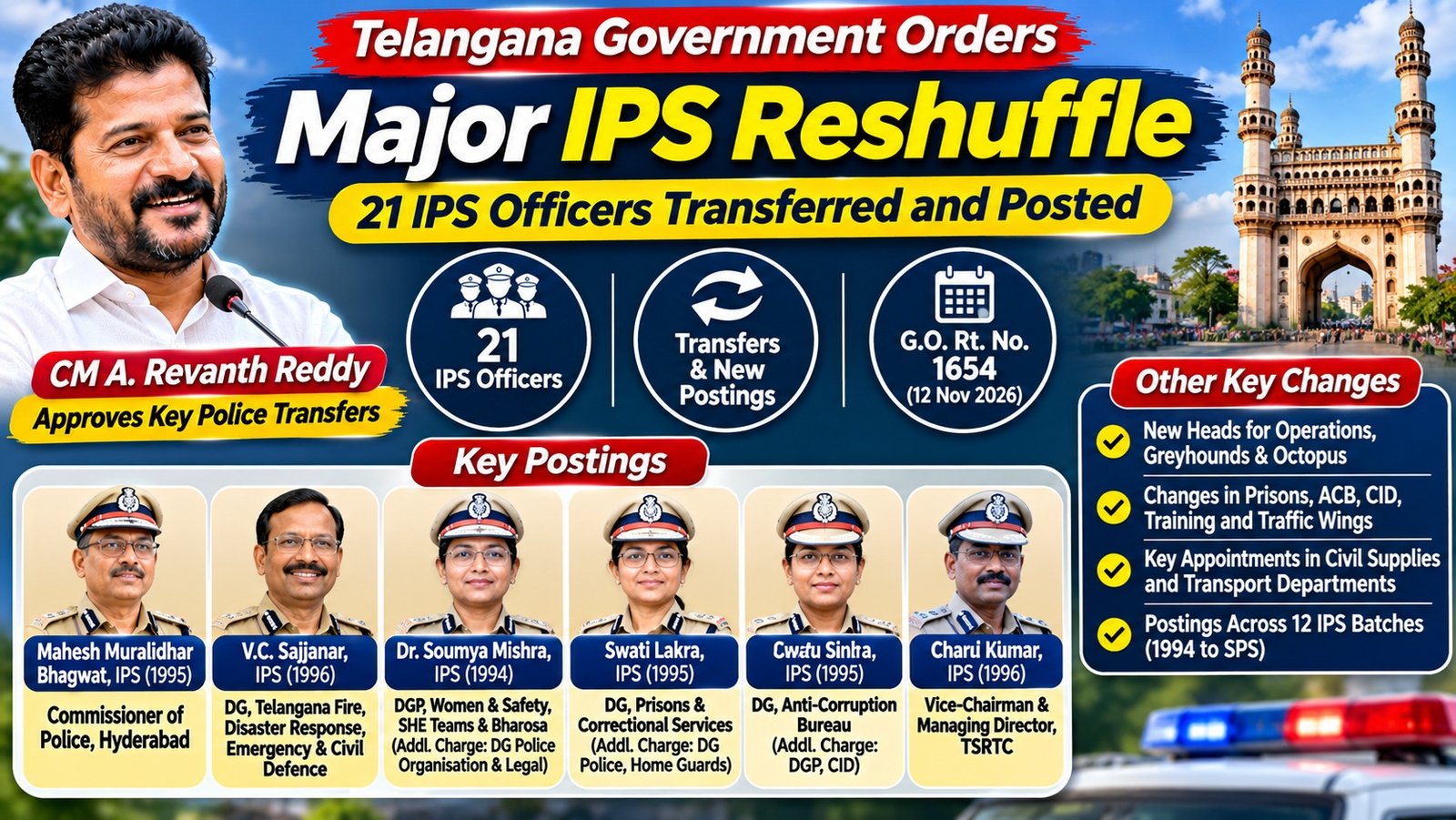
The Telangana government has carried out a significant reshuffle of Indian Police Service officers. On 12 November 2026, the General Administration (Special B) Department issued G.O.Rt.No.1654 notifying transfers and postings of 21 IPS officers. Chief Secretary Sanjay Jaju signed the order in the name of the Governor of Telangana. The changes affect key positions in the state police force, specialised wings, and even non-police departments such as transport and civil supplies.
This large-scale administrative exercise places experienced officers in critical roles ranging from Hyderabad city policing and anti-corruption work to prisons, women safety, fire services, and traffic management. Several officers also receive full additional charges, reflecting the government’s effort to ensure continuity while realigning leadership.
Key Highlights of the Telangana IPS Transfers November 2026
The most high-profile change sees Sri Mahesh Muralidhar Bhagwat, IPS (1995), move from Director General of Police (Law and Order) to Commissioner of Police, Hyderabad. He replaces Sri V.C. Sajjanar, IPS (1996). Sajjanar shifts to the post of Director General, Telangana Fire, Disaster Response, Emergency and Civil Defence. He also holds full additional charge of the Director General, Special Protection Force.
Dr. Soumya Mishra, IPS (1994), previously Director General of Prisons and Correctional Services, now takes charge as DGP, Women and Safety, SHE Teams and Bharosa. She simultaneously holds full additional charge of the Director General of Police (Organisation) and Director General of Police (Legal).
Ms. Swati Lakra, IPS (1995), moves from Director General of Police (Organisation and Home Guards) to Director General of Prisons and Correctional Services. She retains full additional charge of the Director General of Police, Home Guards.
Ms. Charu Sinha, IPS (1996), who held multiple responsibilities including DGP CID and DG ACB, now becomes Director General of the Anti-Corruption Bureau. She continues with full additional charge of the DGP, CID post.
Dr. Anil Kumar, IPS (1996), earlier heading Police Operations, Greyhounds and Octopus, takes over as Vice-Chairman and Managing Director of the Telangana State Road Transport Corporation. Sri Vikram Singh Mann, IPS (1998), replaces him as Director General of Police (Operations), Greyhounds and Octopus, while also holding additional charge of the Director General of Police Housing Corporation.
Complete List of IPS Officers Transferred and Their New Roles
The order covers officers from the 1994 batch down to SPS officers. Here is the detailed breakdown:
- Dr. Soumya Mishra, IPS (1994) – Posted as DGP, Women & Safety, SHE Teams and Bharosa, Hyderabad. Full additional charge of DG Police Organisation and DG Police (Legal).
- Ms. Swati Lakra, IPS (1995) – Posted as Director General of Prisons & Correctional Services. Full additional charge of DG Police, Home Guards.
- Sri Mahesh Muralidhar Bhagwat, IPS (1995) – Posted as Commissioner of Police, Hyderabad.
- Ms. Charu Sinha, IPS (1996) – Posted as Director General, Anti-Corruption Bureau. Full additional charge of DGP CID.
- Dr. Anil Kumar, IPS (1996) – Posted as Vice-Chairman & Managing Director, Telangana State Road Transport Corporation.
- Sri V.C. Sajjanar, IPS (1996) – Posted as Director General, Telangana Fire, Disaster Response, Emergency and Civil Defence. Full additional charge of DG SPF.
- Sri Y. Nagi Reddy, IPS (1997) – Posted as Commissioner, Civil Supplies & Ex-Officio Principal Secretary, CAF&CS Department. Full additional charge of Vice-Chairman & Managing Director, Civil Supplies Corporation, and Controller of Legal Metrology.
- Sri Sanjay Kumar Jain, IPS (1997) – Placed in full additional charge of Additional Director General of Police, Training.
- Sri Vikram Singh Mann, IPS (1998) – Posted as Director General of Police (Operations), Greyhounds & Octopus. Full additional charge of DG Police Housing Corporation.
- Sri M. Stephen Raveendra, IPS (1999) – Posted as Director, Telangana Traffic Management, Road and Rail Safety Bureau (TG-TMARS).
- Sri Akun Sabharwal, IPS (2001) – Posted as Additional Director General of Police (Law & Order). Full additional charge of ADGP Coordination and ADGP Technical Services (T-Spark).
- Sri S. Chandrasekhar Reddy, IPS (2004) – Posted as Director, Anti-Corruption Bureau (relieving previous full additional charge holder).
- Sri Kartikeya, IPS (2006) – Posted as Inspector General of Police, Multi-Zone-I. Full additional charge of Director, ICCC, reporting to DGP through ADGP (Intelligence).
- Sri K. Ramesh Naidu, IPS (2006) – Posted as Inspector General of Police, Railways. Reports to Director, TG-TMARS.
- Sri D. Joel Davis, IPS (2010) – Posted as Joint Director, Road Safety and Joint Director, Traffic, TG-TMARS. Full additional charge of Joint Commissioner of Police, Traffic, Hyderabad City.
- Ms. G. Chandana Deepthi, IPS (2012) – Placed in full additional charge of Deputy Inspector General of Police, Zone-VII, Jogulamba.
- Sri R. Bhaskaran, IPS (2012) – Placed in full additional charge of DIG (Intelligence).
- Sri K. Narayana Naik, IPS (2009) – Placed in full additional charge of DIG, Zone-II, Basara.
- Sri L.S. Chowhan, IPS (2009) – Posted as Deputy Inspector General of Police, Coordination. Full additional charge of DIG, Zone-VI, Charminar.
- Ms. Sree Bala Devi, IPS (SPS) – Posted as Deputy Director (Administration), TG-TMARS.
- Sri V. Aravinda Babu, IPS (SPS) – Posted as Deputy Commissioner of Police, SM&IT, Hyderabad City.
These postings take effect immediately. The order directs all concerned officers and departments to implement the changes without delay.
Why the Government Ordered This Major IPS Reshuffle
Governments periodically reshuffle senior police officers to match experience with current priorities, address performance requirements, and refresh leadership in sensitive wings. Telangana faces ongoing challenges related to urban crime in Hyderabad, women safety, corruption control, disaster preparedness, traffic management, and specialised operations such as anti-Naxal work through Greyhounds.
Placing Mahesh Bhagwat as Hyderabad Police Commissioner brings an officer with extensive law-and-order experience into the state’s largest and most complex police commissionerate. Moving officers with proven track records into women safety, prisons, and anti-corruption roles signals a focus on specialised domains that receive high public and political attention.
The creation and strengthening of TG-TMARS (Telangana Traffic Management, Road and Rail Safety Bureau) through dedicated postings reflects growing emphasis on road safety and traffic systems in a rapidly expanding urban landscape. Assigning senior officers to the transport corporation and civil supplies department also shows the practice of deploying IPS talent beyond traditional policing roles for administrative efficiency.
Detailed Pros of the Telangana IPS Reshuffle
The reshuffle offers several clear advantages for governance and policing effectiveness.
First, it aligns officer expertise with institutional needs. Officers with background in law and order, intelligence, operations, and specialised wings now occupy positions where their experience can deliver immediate impact. Matching skills to roles often improves decision-making speed and operational outcomes.
Second, the changes strengthen focus on priority areas. Women safety receives a dedicated DGP-level officer with additional organisational and legal responsibilities. The Anti-Corruption Bureau gains a full-time Director General. Prisons and correctional services, fire and disaster response, and traffic management all receive dedicated senior leadership. These moves can enhance specialised attention and accountability.
Third, additional charges ensure continuity. By giving full additional charge of previous or related posts to several officers, the government avoids sudden gaps in critical functions. This approach reduces the risk of administrative disruption during the transition period.
Fourth, the exercise refreshes leadership across multiple levels. Bringing mid-senior officers into zone-level DIG posts and joint director roles creates opportunities for capacity building and prepares a wider pool of officers for higher responsibilities in future.
Fifth, deploying IPS officers to departments such as TSRTC and Civil Supplies can inject professional management practices into public sector organisations that deal with large-scale public services and logistics. Experienced police officers often bring strong systems orientation, discipline, and crisis-handling skills to these roles.
Sixth, clear and simultaneous notification of 21 officers reduces speculation and rumour. A comprehensive order issued on a single day allows the administration, media, and public to understand the full picture at once rather than through staggered leaks.
Detailed Cons and Potential Challenges of the Reshuffle
Despite the positive intent, large-scale transfers also carry risks and drawbacks that require careful management.
First, frequent or large reshuffles can disrupt ongoing investigations, projects, and institutional memory. Officers who have built relationships with teams, developed local intelligence networks, or driven specific programmes may leave mid-stream. Successors need time to understand the ground situation, which can temporarily slow momentum.
Second, additional charges increase workload. Several officers now hold two or more significant responsibilities. While this ensures continuity, it can stretch individual capacity, especially in high-pressure domains such as CID, intelligence, or city policing. Overburdened officers may struggle to give equal attention to every charge.
Third, the shift of senior officers into non-police departments sometimes raises questions about the optimal use of specialised policing talent. While administrative experience is valuable, prolonged deployment outside core police functions can reduce the depth of operational leadership available within the force.
Fourth, morale among officers can fluctuate. Those who perceive the moves as recognition may feel motivated, while others who expected different postings or feel the changes lack clear performance linkage may experience uncertainty. Transparent communication about the rationale helps, yet residual perceptions often persist.
Fifth, public-facing roles such as Hyderabad Police Commissioner attract intense scrutiny. Any short-term rise in crime statistics or high-profile incidents during the transition can invite criticism, even if the causes predate the change in leadership. New incumbents face pressure to demonstrate quick results.
Sixth, coordination across wings may face temporary friction. When multiple linked posts change hands simultaneously—such as those connected to traffic, intelligence, operations, and city policing—the new teams need time to establish working rhythms and information-sharing protocols.
Impact on Key Policing Domains in Telangana
Hyderabad city policing now operates under new leadership at the Commissioner level. The city faces complex challenges involving cybercrime, communal sensitivity, traffic congestion, and high-visibility events. The incoming officer’s law-and-order background should help maintain stability while allowing fresh approaches to persistent problems.
Women safety initiatives, including SHE Teams and Bharosa centres, gain dedicated DGP-level oversight. These programmes have been flagship efforts of the Telangana police. Sustained senior attention can improve coordination, resource allocation, and public outreach.
The Anti-Corruption Bureau and CID continue under experienced leadership, with one officer holding both primary and additional charge. This arrangement can facilitate better information flow between anti-corruption and crime investigation functions.
Specialised operational wings such as Greyhounds and Octopus, critical for internal security, receive new leadership at the Director General level. Continuity in these sensitive domains remains essential for state security posture.
Traffic and road safety receive structured attention through TG-TMARS. Multiple officers now hold dedicated or additional roles in this bureau, signalling that the government treats road safety as a priority requiring focused institutional capacity.
How the Reshuffle Fits into Broader Administrative Patterns
State governments routinely use IPS and IAS reshuffles to realign the bureaucracy with policy priorities. In Telangana, the present administration has undertaken several such exercises since assuming office. The November 2026 order stands out for its scale—covering 21 officers in a single notification—and for the mix of core police and inter-departmental postings.
Observers note that the timing, just after other major administrative and policy announcements, suggests an effort to place trusted and experienced officers in positions that will handle the next phase of governance priorities. Whether the changes deliver measurable improvements in crime control, public safety perception, disaster response readiness, and service delivery will become clear over the coming months.
What Citizens and Stakeholders Should Expect Next
Officers will assume their new charges in the coming days. Formal handing-over processes, briefing sessions, and initial reviews of pending matters typically follow such orders. The public can expect continuity in day-to-day policing while new leaders settle into their roles.
Media and civil society will closely watch indicators such as crime statistics in Hyderabad, response times in women safety cases, progress on anti-corruption investigations, and improvements in traffic management and road safety outcomes. Performance in these visible domains will shape public assessment of the reshuffle’s effectiveness.
Conclusion: A Significant Realignment of Police Leadership
The G.O.Rt.No.1654 dated 12 November 2026 marks a major IPS reshuffle in Telangana involving 21 officers. By placing Mahesh Muralidhar Bhagwat as Hyderabad Police Commissioner, strengthening leadership in women safety, prisons, anti-corruption, fire and disaster response, specialised operations, and traffic management, the government has reconfigured senior police architecture across the state.
The moves carry clear potential benefits in terms of expertise matching, priority focus, and administrative continuity. At the same time, they introduce transitional risks related to disruption, workload, and the time required for new teams to stabilise. Effective implementation, clear communication, and sustained support to the newly posted officers will determine whether the reshuffle strengthens Telangana’s policing and governance outcomes in the months ahead.
The order stands as a comprehensive administrative decision that reflects the state’s current priorities and the government’s approach to deploying its senior police leadership.