

 By
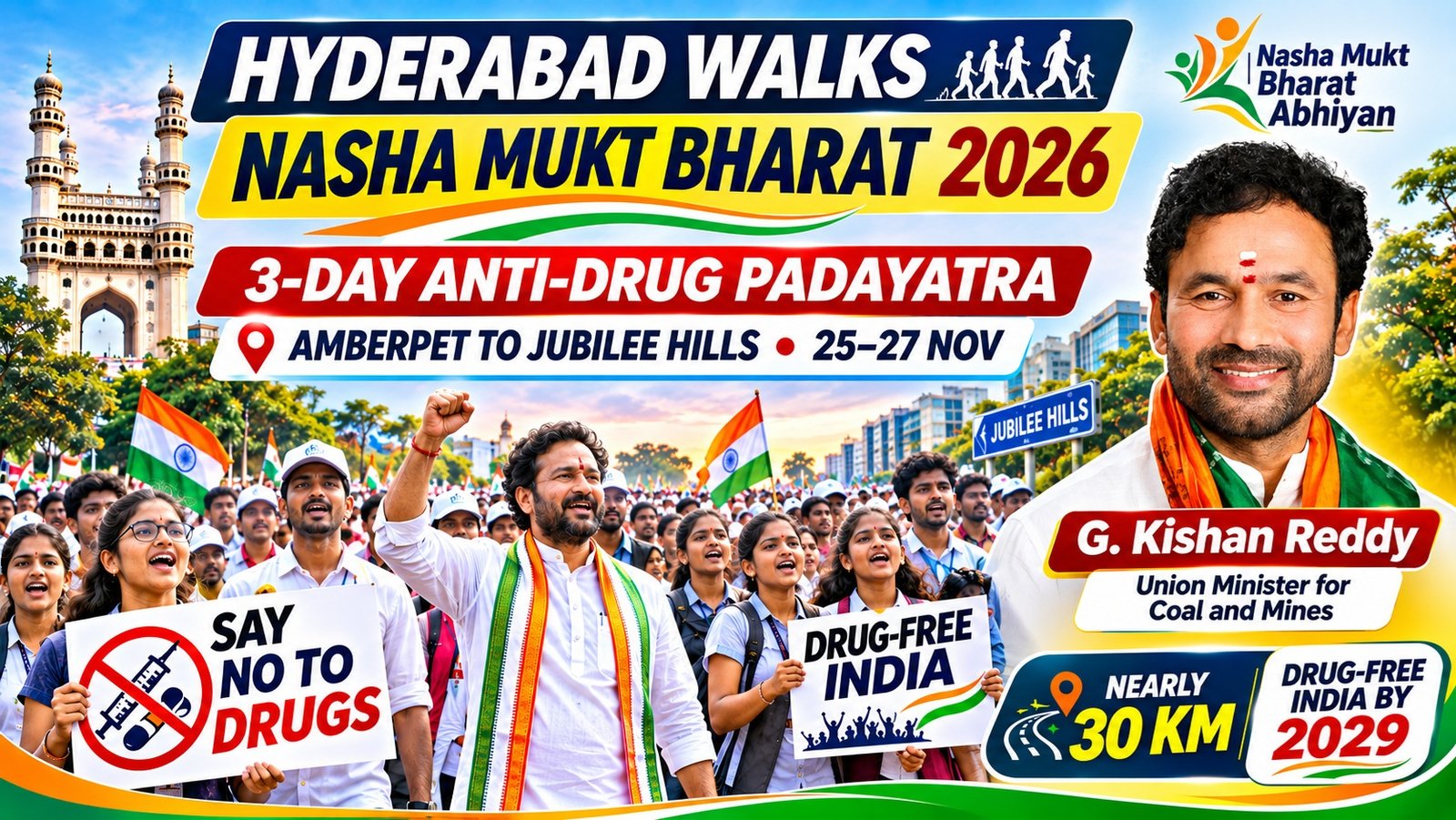
Hyderabad witnessed an extraordinary three-day people’s movement in late November 2026. Thousands of citizens, students, film personalities, spiritual leaders, sportspersons and political representatives walked the streets under the banner of “Hyderabad Walks for Nasha Mukt Bharat.” Led by Union Minister for Coal and Mines G. Kishan Reddy, the padayatra covered nearly 30 kilometres from Amberpet to Jubilee Hills. The campaign formed part of the larger national Nasha Mukt Bharat Abhiyan and carried a clear message: India must become drug-free by 2029.
The walks drew energy from the repeated calls of Prime Minister Narendra Modi and Union Home Minister Amit Shah. Participants repeatedly stressed that protecting the youth remains essential for the vision of a developed India by 2047. What began as a structured awareness march quickly grew into a city-wide expression of resolve.
Understanding the National Context of Nasha Mukt Bharat Abhiyan
The Nasha Mukt Bharat Abhiyan, launched by the Ministry of Social Justice and Empowerment, aims to create a drug-free society through community mobilisation, awareness, prevention and de-addiction support. Hyderabad’s three-day walk translated this national mission into street-level action. Organisers repeatedly reminded participants that external forces and local networks try to lure young people with drugs disguised as everyday items. Parents, teachers and community leaders therefore carry a shared responsibility to protect the next generation.
Union Minister G. Kishan Reddy framed the padayatra as a people’s movement rather than a purely political exercise. He invited every section of society—students, parents, film industry figures, sports icons, spiritual leaders and ordinary citizens—to walk together. The campaign also promoted practical tools: the Nasha Mukt Yuva app for taking the pledge and the helpline numbers 1933 (Anti-Narcotics) and 14446 (De-Addiction).
Day 1: Flag-Off from Amberpet and the March through Educational Hubs
On 25 November 2026 the walk began at Amberpet MCH Ground after special pujas at the nearby Mahankali Temple. Actor Daggubati Venkatesh flagged off the procession. Union Minister G. Kishan Reddy walked alongside students who carried national flags and anti-drug placards. The first day’s route covered approximately 11 to 13 kilometres and passed key landmarks: 6 Number Junction, Tilak Nagar, the Government Fever Hospital, Hindi Mahavidyalaya, the Osmania University entrance, OU Arts College, EFLU, ICMR, Sitaphalmandi, Chilakalguda crossroads, Gandhi Hospital and finally Kashish Function Hall in Musheerabad.
At Osmania University Arts College thousands of students and teachers from OU and EFLU joined the march. They took a collective pledge to stay away from drugs and to work against the menace. MPs Dr K. Laxman, Konda Vishweshwar Reddy and Eatala Rajender, along with actors Nikhil Siddhartha and Payal Rajput, administered the pledge. Spiritual leaders later blessed the participants at Chilakalguda and near Gandhi Hospital. Sri Jnananandagiri Maharaj urged the youth to choose healthy lives.
The first day set a powerful tone. Plays, street performances and strong messages kept energy high. Participants interacted with residents and hospital staff along the route. The night halt at Kashish Function Hall allowed the organisers to plan the next leg while the city continued to discuss the message.
Day 2: Constitution Day Walk from Musheerabad to Ameerpet
The second day, 26 November, coincided with Constitution Day. Participants rose early. Many joined Union Minister G. Kishan Reddy for yoga at 5 a.m. in Musheerabad. Badminton legend and Dronacharya awardee Pullela Gopichand flagged off the day’s march from Kashish Function Hall. He walked with the group till RTC Crossroads and raised the slogans “Say Yes to Sports, Say No to Drugs” and “Say Yes to Exercise, Say No to Drugs.”
The route covered roughly 11 kilometres through RTC X Roads, Ashok Nagar, Himayatnagar, Liberty, the Ambedkar Statue, Municipal Grounds (lunch halt), Bada Ganesh, Khairatabad, Punjagutta and Image Hospital lane before ending near Satyam Theatre in Ameerpet. At the Ambedkar Statue participants paid tributes and took a fresh pledge. The Minister warned that anyone involved in manufacturing, supplying or selling drugs—anywhere in the world—would face strict legal action. He appealed that India must never experience another Punjab-like drug crisis and that young people must become partners in building a developed nation by 2047.
Persons with disabilities joined on wheelchairs. Religious leaders, including H.H. Sri Sri Sri Tridandi Devanatha Jeeyar Swami and H.H. Sri Munchintal Swamy, extended blessings. Music director Vande Mataram Srinivas, activist Manda Krishna Madiga, oncologist Dr Vijayanand Reddy and Padma Shri Kuchipudi dancer Deepika Reddy also participated. The overwhelming public response cut across political lines and social backgrounds.
Day 3: The Final Push through Satyam Theatre, Maitrivanam and Jubilee Hills
On 27 November the padayatra entered its concluding phase. The march resumed from near Satyam Theatre in Ameerpet and moved through Maitrivanam (also referred to as Mythri Nagar), Yousufguda Check Post and Indira Nagar. Participants took pledges at key junctions. Lunch was arranged behind the Jagannath Swami Temple. The walk concluded at Jubilee Hills Public School Ground / the broader Jubilee Hills area after covering approximately 8 kilometres.
This final day attracted an even larger crowd. Film personalities, political leaders, students and ordinary citizens walked side by side. Renowned industrialist and Padma Shri awardee B.V.R. Mohan Reddy joined the padayatra, standing in solidarity with the collective fight against drug abuse. Spiritual leader Sri Sri Ravi Shankar, Megastar Chiranjeevi and actor Akkineni Nagarjuna lent their support, further amplifying the message. The atmosphere remained energetic and disciplined despite the massive turnout.
Union Minister G. Kishan Reddy went live from the route and later addressed the gathering. He noted that the campaign had run successfully for two days with thousands participating from all walks of life. He highlighted that the Prime Minister had granted him special permission to continue the walk instead of attending a Cabinet meeting, underlining the priority given to the anti-drug mission. The Minister reiterated the shared commitment to realise a drug-free India by 2029.
Participants carried placards with clear messages: “Don’t Let Drugs Dictate Your Life,” “Choose Hope Not Dope,” “Break Addiction Build Life” and “Your Future Matters.” The spirit remained unstoppable. Citizens of every age group walked together, proving that the movement had moved beyond any single organisation or political party.
Why the Massive Turnout Matters for Hyderabad and Beyond
The three-day walk succeeded because it combined visibility, celebrity participation, institutional support and genuine public concern. Educational institutions opened their gates. Hospitals and medical colleges offered solidarity. Sports icons demonstrated that physical fitness and drug-free living go hand in hand. Film stars used their reach to normalise the conversation. Spiritual leaders framed the issue as a moral and social duty.
Hyderabad, as a major educational and technology hub, faces particular risks. Young people from diverse backgrounds study and work in the city. Easy access to synthetic drugs and social pressure can destroy careers and families. By taking the message into the streets—past universities, hospitals, residential areas and commercial hubs—the padayatra made the threat visible and the solution collective.
The campaign also reinforced practical support systems. Citizens learned about the helplines 1933 and 14446. Many downloaded the Nasha Mukt Yuva app and took the digital pledge. These tools turn awareness into action long after the walk ends.
The Broader Vision: Drug-Free India by 2029 and Viksit Bharat 2047
Every speaker linked the local walk to the national timeline. A drug-free India by 2029 forms a necessary foundation for the larger goal of a developed nation by 2047. Youth constitute more than a quarter of India’s population. Protecting their potential remains non-negotiable. The Minister repeatedly described the youth as the country’s greatest asset and called on every citizen to become a “Drug-Free Warrior.”
The padayatra demonstrated that political leaders, film industry figures, sportspersons, industrialists and ordinary families can stand on the same platform when the issue concerns the future of the next generation. The presence of B.V.R. Mohan Reddy on the third day underlined the support of the industrial and entrepreneurial community. The expected participation of Chiranjeevi, Nagarjuna and Sri Sri Ravi Shankar on the final stretch showed the cultural and spiritual weight behind the movement.
Continuing the Momentum after the Walk
The three days of walking created visible energy, yet the real work continues in homes, schools, colleges, workplaces and neighbourhoods. Parents must stay alert. Teachers must watch for early signs. Friends must refuse to normalise experimentation. Communities must support de-addiction efforts without stigma. Law-enforcement agencies must pursue manufacturers, suppliers and peddlers without fear or favour.
Citizens can still join the larger movement by downloading the Nasha Mukt Yuva app, taking the pledge, sharing accurate information and supporting those who seek help. Local organisations can organise smaller awareness walks, street plays and counselling camps. Educational institutions can integrate anti-drug modules into regular activities.
A City United for a Drug-Free Future
From the first step at Amberpet on 25 November to the final stretch past Satyam Theatre and Maitrivanam on 27 November, Hyderabad showed what collective resolve looks like. Students walked with film stars. Sportspersons walked with spiritual leaders. Persons with disabilities walked alongside elected representatives. Industrialists stood with ordinary citizens. The massive turnout and unstoppable spirit proved that the city understands the stakes.
The Chief Minister’s Overseas Employment Scheme may open global doors for some youth, yet no opportunity matters if addiction destroys potential at home. The Hyderabad Walks for Nasha Mukt Bharat reminded everyone that protecting young lives is the first and most important investment a society can make.
Let the energy of these three days continue. Let families, educational institutions, workplaces and neighbourhoods keep the conversation alive. Let every citizen treat the fight against drugs as a personal responsibility. Only then will the vision of a Nasha Mukt Bharat by 2029 move from slogan to reality.
Hyderabad has taken a strong step. The rest of the country now watches. The path ahead remains long, yet the direction is clear. Unite, walk, speak and protect. A drug-free society begins with each individual decision and grows through collective action. The youth of Telangana and India deserve nothing less.