
 By
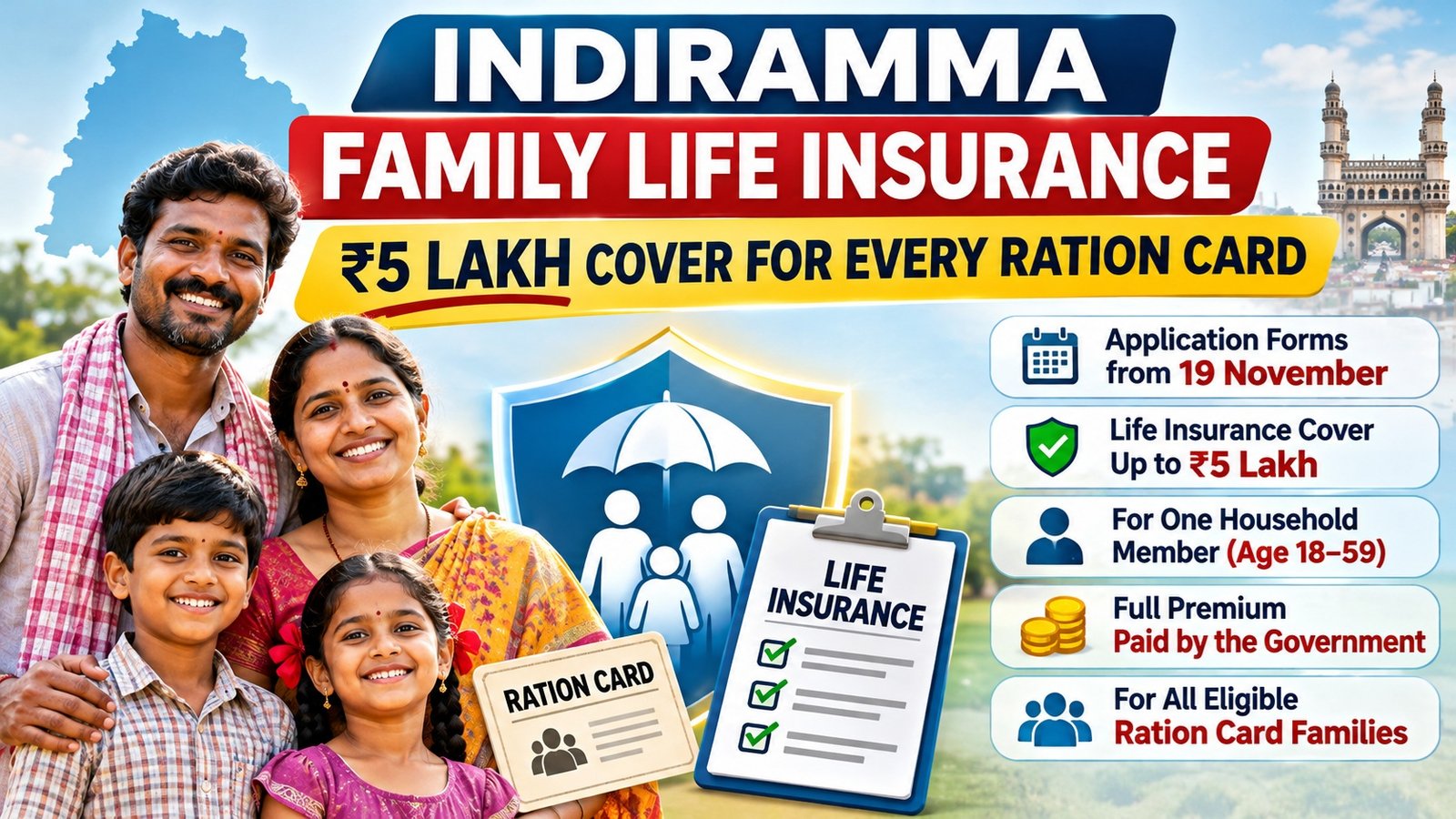
Telangana takes a bold step toward financial security for ordinary families. The state government prepares to roll out the ఇందిరమ్మ కుటుంబ జీవిత బీమా పథకం (Indiramma Kutumba Jeevitha Bheema Pathakam), also known as the Indiramma Family Life Insurance Scheme. Officials begin distributing application forms from Thursday, November 19. Ration card holders across the state stand to receive life insurance cover of up to ₹5 lakh per family. The government pays the entire premium. No family faces income tests or exclusion based on social background.
This scheme marks the first of its kind in India at the state level. It aims to protect households when the main earning member dies suddenly. Families no longer risk falling into deep poverty overnight. Deputy Chief Minister Bhatti Vikramarka has guided the rollout with clear instructions to officials. Chief Minister A. Revanth Reddy will formally launch the registration process on November 19, the birth anniversary of former Prime Minister Indira Gandhi.
What the Indiramma Kutumba Jeevitha Bheema Pathakam Offers
The scheme delivers straightforward protection. Every eligible ration card family receives life insurance cover reaching ₹5 lakh. The cover applies to one primary earning member of the household. If only one person earns income, that individual receives the cover. When more than one member earns, the family decides who receives the insurance protection.
Families also gain flexibility with nominees. Applicants can name one or several nominees. They decide how the insurance amount should split among those nominees. Officials stress the need for careful form filling so that nominee details remain accurate and clear.
The state government bears the full cost of the premiums. Beneficiaries pay nothing. There is no income ceiling. There is no caste or community filter. Universal coverage forms the core principle. Estimates suggest about 1.15 crore families across Telangana will benefit once the scheme reaches full implementation.
Age eligibility remains simple. Any family member aged between 18 and 59 years can serve as the insured person. Officials identify eligible households through the existing ration card system. This approach ensures the process stays practical and reaches people who already interact with the public distribution system.
How Telangana Plans the Form Distribution and Registration Drive
Form distribution begins on November 19. Officials organise the process ration shop by ration shop. This method helps local teams identify every eligible household in a systematic way. On Wednesday, authorities hold meetings with ration shop dealers, government officers, and elected representatives of local bodies. These meetings prepare the ground for smooth camps.
In villages, self-help groups play an active role. SHG members help organise special camps and guide families through the forms. Gram panchayat officers and Mandal Parishad Development Officers act as special officers for the scheme. They collect applications at the gram panchayat level. This decentralised structure aims to bring the process close to people’s homes.
Publicity efforts start early. On November 17 and 18, teams conduct drumbeat announcements in villages. Television, newspapers, and other media channels spread scheme details. Officials must inform people in advance about the exact location and timing of registration centres. After staff enter family details, they must read the information back to applicants and obtain clear confirmation. This step reduces errors and builds trust.
A special mobile app and online application system will also become available. Families who prefer digital methods can use these tools. The combination of offline camps and online options widens access.
Why the Scheme Matters for Telangana Families
Sudden death of an earning member often devastates households, especially in rural and semi-urban areas. Children may leave school. Medical bills pile up. Daily expenses become impossible. The Indiramma Family Life Insurance Scheme steps in as a safety net. The ₹5 lakh payout provides immediate financial support so families can stabilise and plan the next steps.
The scheme treats every ration card family equally. A daily wage labourer receives the same cover as a small trader or a government employee’s family, provided the household holds a valid ration card. This universal approach removes the stigma and paperwork that often accompany income-based welfare schemes.
Deputy Chief Minister Bhatti Vikramarka has repeatedly stressed the human purpose behind the policy. He explains that the government wants families to stand on their feet rather than collapse when they lose their main support. The scheme reflects a broader vision of financial security for every household in the state.
Step-by-Step Guide for Eligible Families
Families can prepare in advance. First, confirm that the household holds a valid ration card. Next, decide which member aged 18 to 59 will serve as the insured person. If multiple earners exist, discuss the choice openly within the family. Prepare the names and details of nominees. Decide the share each nominee should receive.
When forms become available from November 19, visit the designated centre. Bring the ration card and identity documents of the insured member and nominees. Fill the form carefully. Check every entry, especially nominee percentages. After submission, staff will read the details aloud for confirmation.
Those who prefer the digital route can watch for the official app and online portal. Officials will publicise the links and instructions through local media and panchayat announcements.
Collectors and senior officers receive clear directions. They must ensure no eligible family remains left out. Satisfaction levels of registration matter. Incomplete coverage defeats the purpose of universal protection.
Background and Political Context of the Launch
The timing carries symbolic weight. November 19 marks Indira Gandhi’s birth anniversary. Naming the scheme after Indiramma connects the initiative to a longer history of welfare politics in India while giving it a distinctly Telangana identity.
Deputy Chief Minister Bhatti Vikramarka chaired a video conference with all district collectors and senior officials. He outlined operational guidelines and demanded coordinated action across departments. He insisted that registration centres open simultaneously in villages, towns, and cities. He asked teams to create full awareness about the scheme’s purpose and benefits before forms start circulating.
Local elected representatives and ration dealers form part of the coordination structure. Their involvement helps the message reach the last household. Self-help groups, already active in many villages, add grassroots strength to the camps.
Expected Scale and Administrative Arrangements
Around 1.15 crore families are expected to come under the scheme. This number represents a significant portion of Telangana’s population. Implementing a programme of this size requires careful planning. The government has therefore appointed MPDOs as special officers. Gram panchayat staff handle day-to-day application collection. Ration shop networks serve as the identification backbone.
Officials will monitor progress closely. The emphasis remains on complete coverage rather than speed alone. Reading back the filled details to applicants and obtaining their consent forms a mandatory quality check.
Adilabad District Collector Rajarshi Shah has publicly advised citizens to fill forms with care. He noted that the scheme permits multiple nominees, so accuracy in those columns becomes essential. He also confirmed that a special app and online facility would support the process.
Broader Impact on Financial Security in the State
Life insurance penetration in India still remains low, especially among lower-income and rural households. Many families depend on informal networks or simply absorb the shock when a breadwinner dies. A government-funded scheme that requires no premium from the beneficiary changes the equation. It converts a private financial product into a public entitlement linked to the ration card.
The absence of income discrimination matters. Means-tested schemes often exclude families who sit just above arbitrary cut-offs. Universal coverage based on ration cards simplifies administration and removes disputes about eligibility.
When the scheme becomes operational, families that lose an earning member will receive ₹5 lakh. That amount can cover immediate expenses, clear small debts, or support children’s education for a period. It cannot replace a lifetime of earnings, yet it provides breathing space that many households currently lack.
Challenges and the Road Ahead
Large-scale registration always faces practical hurdles. Some families may live in remote hamlets. Others may hold outdated ration card details. Literacy levels vary. Officials must therefore combine physical camps with patient guidance. Self-help group members and panchayat staff will need clear training so they can answer questions accurately.
Digital tools help, yet connectivity and smartphone access remain uneven. The dual offline-online approach reduces the risk that technology becomes a barrier.
Sustained publicity will determine success. Drumbeat announcements, local media, television spots, and word of mouth through SHGs all play a role. People need to understand that the cover is real, the premium is fully paid by the government, and the process stays free of middlemen.
How This Scheme Fits into Telangana’s Welfare Landscape
Telangana has rolled out several family-oriented welfare measures in recent years. The Indiramma Family Life Insurance Scheme adds a new layer focused on risk protection rather than pure cash transfers or subsidies. It complements existing support systems by addressing a specific vulnerability: the sudden loss of household income.
By linking the scheme to the ration card system, the government uses an existing database and delivery network. This choice reduces the need to create entirely new identification processes. It also signals that the public distribution system can serve multiple purposes beyond food security.
Practical Tips for Families Preparing to Apply
Keep the ration card ready and check that names and photographs remain current. Discuss within the family who should be the insured member. Prepare nominee names, ages, and relationship details in advance. Decide the percentage share for each nominee clearly. Attend the local meeting or camp on the announced date. Ask questions if any part of the form remains unclear. Confirm the details when staff read them back.
Those who miss the first round of camps should watch for subsequent opportunities. Officials have received instructions to achieve comprehensive coverage, so additional drives are likely.
Looking Forward
From November 19 onward, Telangana moves from announcement to action. Forms will reach ration shops and gram panchayats. Camps will open. Families will begin registering. The special app and online system will go live. Over the following weeks and months, the state aims to bring 1.15 crore families under the protective umbrella of the Indiramma Kutumba Jeevitha Bheema Pathakam.
The scheme rests on a simple idea: no family should face financial ruin because of the death of its main earner. By paying the premium itself and removing income barriers, the Telangana government turns that idea into a concrete programme. Careful implementation, accurate forms, and widespread awareness will decide how fully the promise reaches every eligible household.
Residents who hold ration cards should treat the coming days as an opportunity to secure this protection. Local officials, ration dealers, self-help groups, and elected representatives all share responsibility for making the registration process smooth and inclusive. When the system works as planned, Telangana will offer its families a measure of financial security that few other states currently match at this scale.
The Indiramma Family Life Insurance Scheme therefore represents more than another welfare announcement. It is a practical commitment to stand behind every household when the unexpected strikes. Form distribution begins this Thursday. The real test of success will appear in the months that follow, as families complete registration and the cover becomes active across the state.