
 By
introduction
Indian Stock Market News Today: Major Business and Market Updates
The latest business developments have brought several companies and sectors into focus, including Tata Steel, APL Apollo Tubes, Varun Beverages, Tata Power, Tata Motors Passenger Vehicles, Bharti Airtel and the National Stock Exchange (NSE). The updates range from regulatory scrutiny and new investments to electric vehicle launches, market valuation milestones and international trade concerns.
One of the biggest developments is the proposed Tata Steel–APL Apollo Tubes transaction, which has attracted attention from the Securities and Exchange Board of India (SEBI) amid questions about related-party transaction rules and the protection of minority shareholders. Meanwhile, the US GDP revision has triggered a political controversy after President Donald Trump demanded an investigation into the earlier economic estimate.
Other important developments include PepsiCo India’s ₹868-crore manufacturing investment in Tamil Nadu, Urban Company’s entry into the air conditioner market, JLR’s upcoming electric Range Rover GT, Airtel’s ₹1,200-crore data centre plan in Assam and NSE’s rise to the world’s third-largest listed stock exchange operator by market capitalisation.
These developments may influence investor sentiment across multiple sectors. However, company announcements, regulatory scrutiny and business expansion plans should be assessed separately from short-term share-price movements.
Tata Steel and APL Apollo Tubes Deal: Why SEBI Is Reviewing the Transaction
The proposed Tata Steel and APL Apollo Tubes transaction has become one of the most closely watched corporate developments in the Indian market. The deal involves Tata Steel transferring its downstream steel tubes and colour-coated steel businesses to APL Apollo Tubes, while Tata Steel plans to acquire a controlling stake in APL Apollo.
The transaction has attracted attention because of its size, structure and potential impact on minority shareholders.
What is the ₹28,000-crore Tata Steel–APL Apollo transaction?
Under the announced structure, APL Apollo Tubes is expected to acquire Tata Steel’s steel tubes business and Tata Steel Colors for a combined consideration of ₹28,000 crore.
The proposed asset transfer includes:
- Tata Steel’s steel tubes business, valued at approximately ₹11,700 crore.
- Tata Steel Colors, valued at approximately ₹16,300 crore.
At the same time, Tata Steel agreed to acquire a promoter stake in APL Apollo Tubes and make an open offer for additional shares. The transaction would give Tata Steel control of APL Apollo while APL Apollo acquires the downstream businesses.
The overall structure is intended to create a larger downstream steel platform. However, investors have raised questions about how the asset purchase will be financed and whether the valuation is appropriate for APL Apollo’s shareholders.
Why is SEBI examining the Tata Steel–APL Apollo deal?
SEBI is examining the proposed transaction amid concerns about related-party transaction (RPT) rules and minority shareholder protection. On November 27, 2026, SEBI Chairman Tuhin Kanta Pandey said the regulator was looking into the deal and that minority shareholder interests were important.
The key concern is whether the connected transactions should be assessed together rather than as separate steps. Investors and proxy advisory firms have questioned whether the structure could avoid the scrutiny that might apply if the transactions were treated as a single related-party arrangement.
The concern is particularly relevant because Tata Steel is expected to become APL Apollo’s controlling shareholder while APL Apollo purchases assets from Tata Steel.
What are the concerns for APL Apollo shareholders?
APL Apollo’s minority shareholders are concerned about the potential financing burden. If the company borrows heavily to acquire the ₹28,000-crore assets, its debt could increase substantially.
Investors are also assessing:
- The valuation of the acquired businesses.
- The expected returns from the asset purchase.
- The impact of debt on future cash flows.
- Whether the transaction benefits the incoming controlling shareholder disproportionately.
- The safeguards available to minority shareholders.
These concerns do not establish that the transaction violates regulations. They explain why the deal has attracted regulatory and investor attention.
What could happen next?
The companies may revise the transaction structure following investor concerns. SEBI is expected to examine the revised proposal and assess whether the arrangement complies with applicable rules.
The transaction remains subject to regulatory approvals and further developments. Investors should therefore avoid treating the deal as fully completed or assuming that the original structure will remain unchanged.
The Tata Steel–APL Apollo transaction is an important example of how a strategically ambitious corporate deal can also create governance and financing questions.
PepsiCo India Investment: ₹868 Crore Food Manufacturing Plant in Tamil Nadu
PepsiCo India has announced an investment of ₹868 crore in a new food manufacturing facility at Manapparai in Tamil Nadu. The development is significant for the company’s manufacturing network and for the region’s industrial activity.
The plant is planned at the SIPCOT Industrial Park in Kannudaiyanpatti, near Manapparai, and will manufacture snack products including Lay’s and Kurkure.
The facility is expected to:
- Strengthen PepsiCo’s manufacturing presence in southern India.
- Improve supply-chain efficiency by bringing production closer to consumers.
- Create approximately 650 direct and indirect jobs.
- Support local businesses and related industries.
- Increase production capacity for the company’s snack brands.
Commercial operations are expected to begin by July 2028, according to company officials reported in the news coverage.
Why is this development relevant to Varun Beverages?
Varun Beverages (VBL) is an important PepsiCo bottling partner in the beverage business. However, the announced Tamil Nadu facility is a food manufacturing investment by PepsiCo India, not a VBL beverage plant.
The investment may be relevant to the broader PepsiCo ecosystem and consumer-products sector, but investors should not automatically attribute the plant’s investment amount, capacity or earnings impact to Varun Beverages.
VBL’s performance should be assessed using its own financial results, beverage volumes, distribution network, margins and business updates.
Urban Company Enters the Air Conditioner Market
Urban Company has expanded beyond its service platform and smart-home products by entering the residential air conditioner market under its Native brand.
The company has introduced two AC models, Native Ultra and Ultra Air. The product launch is drawing attention because of the warranty package and the company’s existing experience in AC servicing and repairs.
Five-year unconditional warranty and gas refills
The new AC range is reported to include a five-year unconditional warranty, including gas refills, along with a 10-year compressor warranty.
This offer could appeal to consumers who want to reduce maintenance uncertainty and avoid unexpected repair costs during the initial years of ownership.
The company’s service experience may also help it understand common customer complaints and maintenance requirements. However, the actual success of the product will depend on cooling performance, reliability, pricing, installation quality and customer service.
Could Urban Company challenge Voltas and Blue Star?
The AC market already includes established brands such as Voltas and Blue Star. Urban Company’s warranty proposition may increase competitive pressure, particularly if customers value long-term service coverage.
However, a warranty alone does not guarantee market leadership. Established manufacturers have extensive distribution networks, product ranges, manufacturing capabilities and brand recognition.
For investors, the important factors will be product sales, customer response, warranty costs, service execution and whether the new category contributes meaningfully to Urban Company’s revenue and profitability.
Tata Power’s Digital Command Centre and Business Innovation
Tata Power continues to focus on operational improvements and the development of technology-led solutions across its businesses.
The transcript refers to the company introducing innovative digital command centres to support different business operations. Such systems can help companies monitor assets, coordinate operations and improve the visibility of performance data.
Digital infrastructure can be particularly relevant in power generation, distribution, renewable energy and customer-service operations.
However, the transcript does not provide detailed information about the command centre’s location, investment amount, operational scope or expected financial contribution. Those details should not be assumed.
For Tata Power shareholders, the broader business outlook will continue to depend on execution across power generation, distribution, renewable energy, project development, capital expenditure and financial performance.
JLR Electric Vehicle News: Range Rover GT EV Expected in Early 2027
Jaguar Land Rover (JLR), part of Tata Motors Passenger Vehicles, is preparing to expand its electric vehicle portfolio.
The Range Rover GT is expected to make its full debut in early 2027 in an all-electric version. JLR has also outlined plans for additional electric models, including the electric Defender.
The Range Rover GT is expected to use JLR’s new Electrified Modular Architecture (EMA), designed for next-generation electric vehicles.
Why is the Range Rover GT important for Tata Motors?
JLR’s product performance is an important factor for Tata Motors Passenger Vehicles because the luxury vehicle business contributes to the group’s overall results and brand positioning.
The launch of new electric models could help JLR:
- Expand its electric vehicle portfolio.
- Attract customers seeking premium electric SUVs.
- Strengthen its position in the luxury EV segment.
- Support its longer-term electrification strategy.
- Refresh its product lineup with new technology and design.
Will the Range Rover GT help JLR recover?
A new product launch can create an opportunity, but it does not guarantee a business recovery or a rise in the share price.
The actual impact will depend on customer demand, pricing, production readiness, delivery timelines, competition and profitability. Investors should also monitor JLR’s overall sales, margins, cash flow and market conditions.
The Range Rover GT is a development to watch, but its future contribution should be assessed after the company provides more information about launch timing, specifications and market response.
India–US Trade Deal: Tariff Threat and Make in India Concerns
The India–US trade relationship remains an important issue for exporters, manufacturers and investors.
The transcript refers to a proposed US tariff rate of 25% and a possible reduction to 17% if India and the United States sign a trade agreement. A recent report cited a Jefferies analysis suggesting that the tariff threat could encourage both countries to move towards a trade deal.
According to the report, a proposed tariff framework could allow India’s rate to fall to 17% under a reciprocal trade agreement. The proposal was still subject to further proceedings, including public hearings scheduled for January 2027.
Which Indian sectors could be affected?
Trade policy can influence several sectors, including:
- Chemicals and specialty chemicals.
- Textiles and apparel.
- Capital goods.
- Manufacturing and industrial products.
- Export-oriented businesses.
Companies that rely heavily on the US market may be more sensitive to changes in tariffs. A higher tariff could affect their competitiveness, pricing power and order flow.
Could a trade deal affect Make in India?
A trade agreement can create both opportunities and challenges.
Lower tariffs may improve access to the US market for Indian exporters. At the same time, greater access for imported goods could increase competition for some domestic manufacturers.
The actual impact would depend on the agreement’s terms, product-specific tariff schedules, rules of origin, safeguards and implementation timeline.
Investors should not assume that a trade deal would automatically benefit or harm every Indian company. The effect would vary by industry and business model.
Jet Airways Employees: ₹480 Crore in PF and Gratuity Dues
Former Jet Airways employees have received a major development after a long legal battle over their statutory dues.
The National Company Law Appellate Tribunal (NCLAT) directed the release of approximately ₹480 crore in provident fund and gratuity dues to former employees within two weeks, according to reports dated November 26–27, 2026.
The direction provides relief to workers who have been waiting for their dues for several years.
What does the tribunal’s direction mean?
The reported direction provides for gratuity payments to be transferred directly to eligible employees’ bank accounts, while provident fund amounts are to be deposited through the Employees’ Provident Fund Organisation (EPFO).
The detailed written order was still awaited in the reports.
Jet Airways suspended operations in 2019 and later entered insolvency proceedings. The employee dues issue became part of a prolonged legal process involving employees, the liquidator and other stakeholders.
Why is this important for investors?
Jet Airways is no longer an operating airline in the normal sense, and this employee-related development should not be interpreted as a business revival or a stock-market investment opportunity.
The case is primarily important for former employees and for the treatment of statutory dues during insolvency proceedings.
It also highlights the risks associated with assuming that a once-prominent company will remain successful indefinitely. Financial distress, legal disputes and operational challenges can fundamentally change a company’s future.
NSE Becomes the World’s Third-Largest Listed Exchange Operator
The National Stock Exchange of India (NSE) has reached a significant market valuation milestone.
NSE’s market capitalisation reportedly rose to approximately $64 billion, placing it ahead of Deutsche Boerse and the London Stock Exchange Group and making it the world’s third-largest listed stock exchange operator by market capitalisation.
The ranking was reported after NSE shares advanced to a fresh post-listing high on November 26, 2026.
What supported NSE’s market valuation?
NSE’s position reflects its strong role in India’s capital markets, including its participation in equities, derivatives and other market segments.
The company’s valuation can be influenced by:
- Trading volumes.
- Market participation.
- Exchange revenue.
- Listing and transaction activity.
- Investor expectations about India’s capital-market growth.
However, a higher market capitalisation does not automatically mean that the stock is undervalued.
HSBC coverage and NSE share price
The transcript also mentions HSBC initiating coverage of NSE. A report cited a ‘Hold’ rating and a target price of ₹2,300, while the stock had traded above that level during the recent rally.
Brokerage ratings and price targets are opinions based on assumptions. They can change as market conditions and company performance evolve.
Investors should evaluate NSE using its earnings, valuation multiples, growth prospects, regulatory environment and the sustainability of trading activity.
Bharti Airtel’s ₹1,200-Crore Data Centre Investment in Assam
Bharti Airtel has announced plans to invest approximately ₹1,200 crore in three data centres in Assam.
The facilities are planned for Guwahati, Jorhat and Silchar, with a combined capacity of around 40 MW.
The investment follows an agreement with the Assam government and is expected to support the state’s digital infrastructure.
What is the expected impact?
The data centres could support growing demand for cloud services, digital applications, enterprise connectivity and data storage.
The project is also expected to create employment and support local economic activity.
For Airtel, data centre investment is part of the broader opportunity created by increasing digital consumption and enterprise demand.
However, data centres require substantial capital expenditure, power supply, cooling systems, network infrastructure and operational expertise. The long-term returns will depend on utilisation, customer contracts, cost management and execution.
Tata Sons and Noel Tata: Governance Disagreement Continues
The Tata Group has also been in the news because of ongoing governance discussions at Tata Sons.
Reports indicate that Noel Tata raised objections regarding the agenda and notice for a Tata Sons board meeting. The meeting was rescheduled to November 30 after concerns about the notice period and matters proposed for discussion.
The dispute reportedly involves board procedures, agenda items and requests related to earlier notices.
These developments should be described as a governance disagreement rather than evidence of wrongdoing.
Why does Tata Sons governance matter?
Tata Sons is the holding company of the Tata Group, and its governance can influence discussions around group strategy, leadership, capital allocation and the listing status of the holding company.
However, governance developments at Tata Sons do not automatically translate into immediate changes in the operations or share prices of every listed Tata company.
Investors should assess each listed entity separately, including Tata Steel, Tata Motors, Tata Power and other group companies.
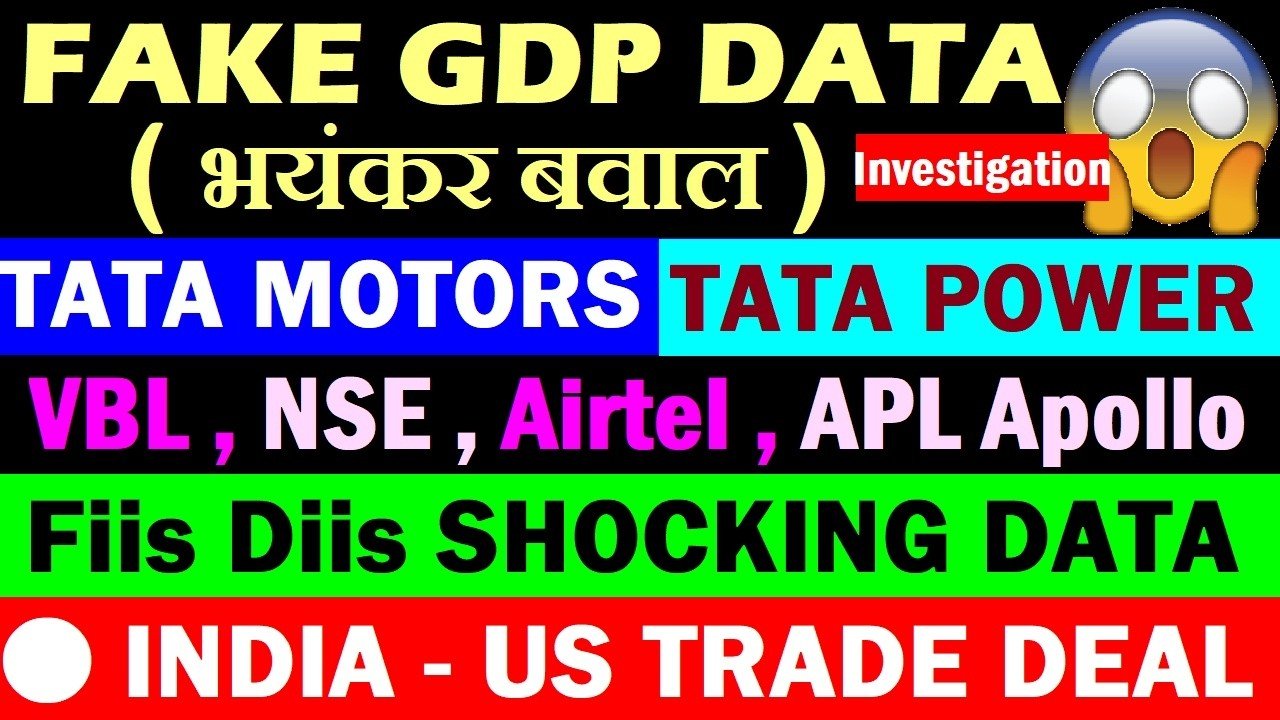
US GDP Data Controversy: Trump Calls Earlier Figures ‘Fake’
One of the most widely discussed international developments concerns the revision of US third-quarter GDP growth.
The US Bureau of Economic Analysis (BEA) revised annualised GDP growth for the third quarter of 2026 from an initial estimate of 3.4% to 4.3% in its second estimate released on November 25.
President Donald Trump subsequently demanded an investigation, alleging that the earlier figures were deliberately wrong and calling them “fake.” The allegation has not been substantiated.
Why was US GDP growth revised from 3.4% to 4.3%?
GDP estimates are released in stages because the government does not have complete data immediately after a quarter ends.
The BEA explained that the upward revision primarily reflected changes in estimates of investment and consumer spending. GDP estimates can be revised as additional information becomes available.
The 4.3% figure is the second estimate for the third quarter, not proof that the earlier estimate was intentionally manipulated.
Does a GDP revision mean the data was fake?
No. A revision is a normal part of economic measurement.
The initial estimate is based on incomplete information, while later estimates incorporate more complete or updated data. A large revision can raise questions and prompt scrutiny, but it does not by itself establish fraud or political interference.
Trump’s demand for an investigation is a political and administrative development. The claim that the earlier data was deliberately falsified remains an allegation.
Why should Indian investors watch US GDP?
The US economy can influence global markets through interest-rate expectations, consumer demand, trade, currency movements and investor sentiment.
A stronger US growth estimate may affect expectations about the Federal Reserve’s policy path. However, the market impact depends on inflation, employment data, bond yields and other economic indicators.
Indian investors should avoid interpreting one GDP revision as a guaranteed signal for the Nifty or Sensex.
Market Outlook: What Investors Should Monitor
The developments in this transcript cover several different themes: corporate governance, manufacturing investment, electric vehicles, digital infrastructure, trade policy and global economic data.
The most important points to monitor include:
- Tata Steel–APL Apollo: Watch for a revised transaction structure, regulatory developments and details protecting minority shareholders.
- Varun Beverages: Track VBL’s own financial performance rather than attributing PepsiCo’s food-plant investment directly to the bottler.
- Tata Motors Passenger Vehicles: Monitor JLR sales, margins, cash flow and customer response to new electric vehicles.
- Urban Company: Assess AC product demand, warranty costs and the company’s ability to compete with established brands.
- Bharti Airtel: Follow data centre execution, capacity utilisation and returns on capital expenditure.
- NSE: Review valuation and earnings growth instead of relying only on its global market-cap ranking.
- India–US trade: Track the final tariff framework and its effect on specific export sectors.
- US GDP: Distinguish routine statistical revisions from unverified allegations of deliberate manipulation.
Market movements can occur before the financial impact of these developments becomes clear. Investors should therefore separate news-driven volatility from changes in business fundamentals.
Frequently Asked Questions
Why is SEBI reviewing the Tata Steel–APL Apollo deal?
SEBI is examining the transaction structure amid concerns about related-party transaction rules, financing, valuation and the interests of APL Apollo’s minority shareholders. The regulator’s review does not itself establish a violation.
What is the value of the Tata Steel–APL Apollo transaction?
The proposed transfer of Tata Steel’s downstream tubes and colour-coated steel businesses to APL Apollo is valued at approximately ₹28,000 crore. The wider transaction also includes Tata Steel’s proposed acquisition of a controlling stake in APL Apollo.
What is PepsiCo India’s investment in Tamil Nadu?
PepsiCo India announced an investment of ₹868 crore in a new snack manufacturing facility near Manapparai, Tamil Nadu. The plant is expected to manufacture Lay’s and Kurkure products and create around 650 direct and indirect jobs.
What is new in Tata Motors and JLR?
JLR has confirmed plans for the all-electric Range Rover GT, expected to debut in early 2027. The company is also developing additional electric models as part of its electrification strategy.
Why did US GDP growth increase from 3.4% to 4.3%?
The BEA revised its third-quarter 2026 annualised GDP estimate upward in its second release, primarily due to revised estimates for investment and consumer spending. GDP revisions are a normal part of the statistical process.
Is the US GDP data controversy proven?
No. President Trump alleged that the earlier estimate was deliberately wrong and called for an investigation, but the allegation has not been substantiated. The BEA’s explanation cited updated economic data.
Why is NSE in the news?
NSE reportedly became the world’s third-largest listed stock exchange operator by market capitalisation, ahead of Deutsche Boerse and the London Stock Exchange Group.
What is Airtel’s investment in Assam?
Bharti Airtel plans to invest approximately ₹1,200 crore in three data centres in Guwahati, Jorhat and Silchar, with a combined capacity of around 40 MW.
Conclusion
The latest business and market updates highlight how regulatory scrutiny, corporate transactions, manufacturing investments and new product launches can shape investor sentiment.
The Tata Steel–APL Apollo transaction remains a key development because of its scale and the questions raised about financing and minority shareholder protection. PepsiCo India’s Tamil Nadu plant, Airtel’s Assam data centres and JLR’s upcoming electric vehicles represent longer-term business expansion plans.
Meanwhile, the US GDP controversy illustrates the importance of understanding how economic data is revised and distinguishing political allegations from verified findings.
For investors, the most effective approach is to evaluate each company based on its own fundamentals, official disclosures, financial performance and execution—not solely on headlines or short-term share-price movements.
Investment disclaimer: This article is for informational and educational purposes only. It is not investment advice or a recommendation to buy or sell any stock. Investors should conduct their own research and consult a qualified financial adviser before making investment decisions.
Suggested URL Slug: indian-stock-market-news-tata-steel-apl-apollo-sebi-us-gdp-nse-airtel-jlr
Meta Description: Indian stock market news: SEBI reviews the Tata Steel–APL Apollo deal, PepsiCo invests ₹868 crore in Tamil Nadu, JLR plans the Range Rover GT EV, Airtel invests in Assam data centres and US GDP data faces controversy.