
 By
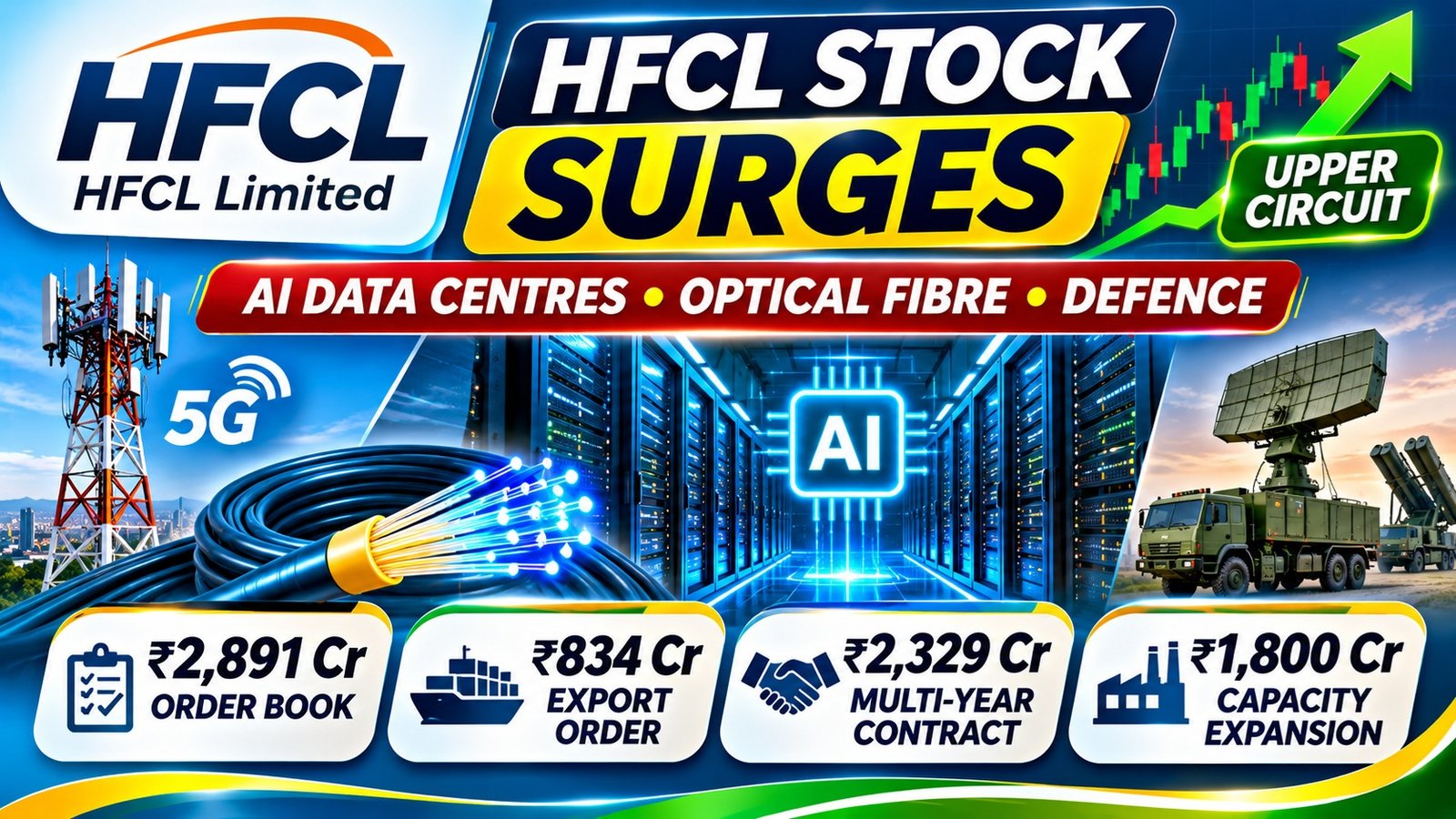
HFCL Limited has returned to the spotlight after a period of sharp price correction. The stock recently hit the upper circuit as buyers returned in force. Market participants linked the rebound partly to improving sentiment around artificial-intelligence infrastructure and data-centre investments. This article examines the company’s recent developments, order-book visibility, exposure to high-growth segments, and the broader factors shaping its trajectory.
Understanding HFCL’s Core Business and Market Position
HFCL operates primarily in the telecommunications infrastructure space. The company manufactures optical-fibre cables, telecom equipment and related products that form the backbone of modern communication networks. It also maintains a growing presence in defence electronics and related systems. While HFCL is not an artificial-intelligence pure-play company, its products play an enabling role in the infrastructure that supports AI workloads, cloud computing and high-speed data transmission.
Over the past year the stock delivered substantial returns, rising approximately 145 percent even after the recent correction. Such performance reflects both the earlier optimism around India’s digital infrastructure push and the subsequent profit-booking that pulled the price lower. The latest upper-circuit move signals that fresh demand has re-emerged at lower valuation levels.
Recent Price Action and the Upper-Circuit Trigger
The stock had been under pressure for several weeks. Selling intensified whenever broader market sentiment toward AI-linked names weakened. Once AI-related stocks began recovering, buying interest returned to HFCL as well. With limited sellers available at lower levels, the shares quickly hit the upper circuit.
Market observers note that the company’s valuation had compressed meaningfully during the decline. At the time of the rebound the company reported an earnings per share of ₹5.67. Promoter holding remains relatively low, yet institutional participation has shown constructive trends. The combination of a sizeable order book and improving sectoral sentiment appears to have attracted fresh capital.
Strong Order Book Provides Multi-Year Revenue Visibility
One of the most important positives for HFCL is its order book. The company currently holds orders worth approximately ₹2,891 crore. Against a market capitalisation of around ₹26,400 crore, the order book represents a meaningful portion of future revenue that is already contracted.
A fresh export order for optical-fibre cables worth ₹834 crore has added to the pipeline. In addition, HFCL secured a large multi-year optical-fibre-cable supply agreement valued at ₹2,329 crore. Delivery under this contract is expected to stretch from 2027 through 2029. Such long-duration contracts provide revenue visibility that extends well beyond the immediate quarters.
Management continues to win new business even while executing the existing backlog. The presence of both domestic and international customers reduces concentration risk and supports a more balanced growth profile.
Capacity Expansion to Match Rising Demand
HFCL has outlined an expansion investment plan of approximately ₹1,800 crore. A significant portion of this capital will increase optical-fibre-cable manufacturing capacity. The company is expanding production capability precisely because order inflows have remained strong. Management recognises that sustained demand from telecom operators, data-centre developers and export markets requires higher throughput.
Capacity addition is a double-edged sword. On one hand it positions the company to capture larger volumes. On the other hand, successful execution depends on timely commissioning, efficient utilisation and stable input costs. Investors typically monitor the pace at which new capacity comes on stream and the corresponding improvement in sales.
AI Data Centre Boom and the Demand for Optical Fibre
The rapid build-out of artificial-intelligence infrastructure has created fresh demand for high-capacity optical networks. Large language models, cloud platforms and enterprise AI applications require massive data movement between servers, storage systems and end users. Low-latency, high-bandwidth connectivity is essential.
Optical-fibre cables form the physical layer of this connectivity. Data centres need dense fibre interconnections both inside facilities and between facilities. Cloud service providers continue to expand their Indian footprints, while global technology companies invest in AI-ready infrastructure. HFCL’s products sit directly in this value chain.
The company does not develop AI algorithms or train models. Its contribution lies in the physical infrastructure that makes high-speed data transfer possible. As long as data-centre construction and network upgrades continue, demand for quality optical-fibre solutions is likely to remain supportive.
Telecom Infrastructure Tailwinds – 5G, BharatNet and Broadband Expansion
India’s telecom sector continues to invest in network densification and coverage expansion. 5G deployment requires denser fibre backhaul. BharatNet and other rural broadband initiatives create additional demand for optical connectivity. Telecom operators also upgrade existing networks to handle rising data traffic.
HFCL supplies cables and equipment that support these projects. The combination of domestic telecom spending and export opportunities gives the company multiple avenues for growth. Management has indicated that the current order book already covers a meaningful portion of the next one to two years of activity, while new orders continue to arrive.
Defence and Aerospace Diversification
Beyond telecom and data centres, HFCL has entered the defence and aerospace segment. The company supplies or develops products in areas such as thermal imaging systems, radar and surveillance equipment, and electronic fuse systems. Management has set a target of generating at least ₹500 crore of revenue from the defence vertical by the end of 2027.
In parallel, the broader sales target for the company stands at approximately ₹2,000 crore over the next two years. Achieving these numbers would represent a substantial step-up from current levels. If the company can maintain healthy operating margins while scaling revenue, profitability has scope to expand meaningfully.
Defence orders typically involve longer qualification cycles and stringent quality requirements. Successful execution in this segment can improve the quality and predictability of the overall revenue mix.
Shareholding Pattern Shifts – Institutions Increase, Retail Declines
An interesting development has been the change in shareholding composition. Retail investors previously held more than 50 percent of the equity, at one point around 56 percent. That stake has declined to approximately 44 percent. At the same time, foreign institutional investors and domestic institutional investors have increased their holdings.
Rising institutional ownership often signals greater confidence in the medium-term business outlook. Institutions tend to conduct deeper due diligence on order books, margin sustainability and capital allocation. The shift in ownership therefore provides an additional data point for market participants evaluating the stock.
Reasons Behind the Recent Price Correction
Several factors contributed to the earlier decline. The stock had already delivered strong multi-bagger returns over the preceding period, prompting profit booking. Elevated expectations around AI-related demand created valuation premiums that later compressed when sentiment cooled. Technical selling and general market volatility added further pressure. Execution risks associated with large order books and capacity expansion also weighed on some investors’ minds.
Importantly, the decline in share price did not coincide with a collapse in the underlying business. Sales, operating profit and net profit continued to show improvement even as the stock corrected. The company continued to pay taxes and report growth. This divergence between business performance and stock performance often creates the conditions for subsequent recovery once sentiment stabilises.
Financial and Operational Momentum
The company has demonstrated improving operating metrics. Margins have expanded, operating profit has risen, and net profit has shown multi-fold improvement in recent periods. These trends support the view that the business itself remains healthy even during phases of share-price weakness.
Order execution remains a key variable. The company holds a large backlog relative to its current manufacturing capacity. The speed at which it converts orders into revenue and cash flow will influence near-term financial results. Successful capacity addition should ease this constraint over time.
Balancing Opportunity and Execution Risk
HFCL sits at the intersection of several structural themes: India’s digital infrastructure build-out, global data-centre expansion driven by AI, export demand for optical-fibre products, and domestic defence modernisation. Each of these themes can support multi-year growth.
At the same time, the company must execute large orders on time, manage working capital efficiently, commission new capacity without major delays, and maintain product quality across telecom and defence applications. Any significant slippage on these fronts could affect both financial performance and investor sentiment.
Longer-Term Perspective
Looking beyond the immediate quarters, the combination of a robust order book, capacity expansion, and exposure to high-growth end markets provides a foundation for continued business expansion. The multi-year optical-fibre supply agreement running into 2029 already locks in a portion of future revenue. Additional orders from telecom, data-centre and defence customers can further extend visibility.
Investors who follow the stock typically focus on quarterly order inflows, execution progress, margin trends, and updates on the defence revenue ramp. Shareholding changes and institutional commentary also provide useful signals.
Conclusion – Fundamentals Remain the Anchor
HFCL Limited has experienced the full cycle of strong returns, subsequent correction, and a sharp rebound. The upper-circuit move reflects renewed buying interest after valuations compressed and sectoral sentiment improved. The company’s order book of nearly ₹2,900 crore, fresh export wins, multi-year supply contracts, and planned capacity expansion of ₹1,800 crore form the core of the near-to-medium-term story.
Exposure to optical-fibre demand from AI data centres, 5G and broadband networks, and a growing defence electronics portfolio adds further dimensions to the growth narrative. Institutional investors have increased their stakes even as retail participation moderated, suggesting a shift toward longer-term holders.
As with any manufacturing and infrastructure company, execution remains critical. The pace of capacity addition, the conversion of orders into revenue, and the ability to scale the defence vertical will shape financial outcomes over the coming years. Market participants will continue to monitor these variables closely while the broader themes of digital infrastructure and defence modernisation unfold in India and overseas.
The recent price recovery demonstrates that investor interest returns when business momentum and valuation align. HFCL’s trajectory from here will depend on how effectively management converts its current order book and expansion plans into sustained operational and financial performance.