
 By
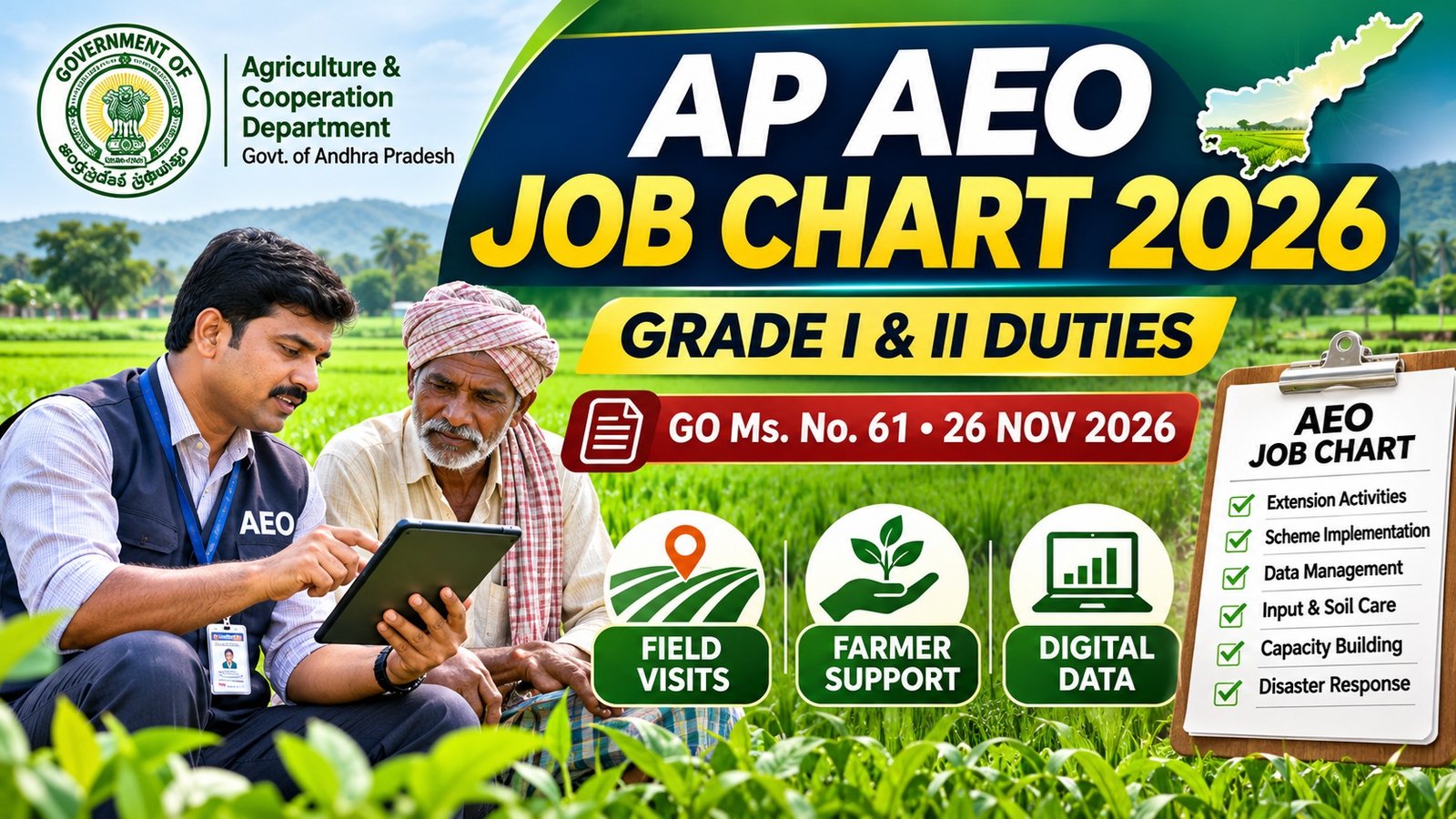
The Government of Andhra Pradesh has issued a clear and updated job chart for Agricultural Extension Officers in Grade I and Grade II. Through G.O. Ms No. 61 dated 26 November 2026, the Agriculture and Cooperation Department has defined the exact responsibilities these officers must carry out in the field. The order aims to remove confusion about roles, improve efficiency at the ground level, and ensure that farmers receive uninterrupted support through key agricultural programmes and digital platforms.
Agricultural Extension Officers form the vital link between government schemes and the farming community. They work closest to the villages, guide cultivators, collect accurate data, and help implement both state and central initiatives. The new job chart responds to changing agricultural conditions, the rise of digital tools, and the need for consistent service delivery across Andhra Pradesh. By spelling out duties in detail, the government expects better coordination, stronger accountability, and improved outcomes for farmers.
Understanding the Role of Agricultural Extension Officers in Andhra Pradesh Agriculture
Agricultural Extension Officers serve as the frontline force of the state agriculture department. They operate at the circle level and within Rythu Seva Kendras, bringing technical knowledge, scheme benefits, and advisory services directly to farmers. In a state where agriculture employs a large section of the population and contributes significantly to the rural economy, the performance of these officers directly affects crop productivity, input use, and farmer incomes.
The Director of Agriculture at Guntur submitted detailed proposals after studying field realities. The government examined those proposals carefully and approved a structured job chart that covers general conduct, extension work, data handling, soil care, input management, capacity building, and disaster response. Officers posted in soil testing laboratories, soil conservation offices, district resource centres, farmer training centres, district offices, and SAMETI must also follow the general activities listed in the order while performing specialised tasks assigned by higher authorities.
Key Objectives Behind the New Job Chart for AEOs Grade I and II
The primary goals of this government order are straightforward. First, it seeks to eliminate role ambiguity so that every AEO knows exactly what the department expects. Second, it aims to raise field-level efficiency by setting clear standards for attendance, reporting, field visits, and programme implementation. Third, it streamlines the delivery of flagship schemes and digital platforms so that farmers experience fewer delays and better service.
The order also stresses professional behaviour and strict adherence to rules. Officers must stay away from any illegal or fraudulent activity. Any misconduct invites disciplinary action under the relevant CCA rules. This emphasis on integrity protects both the department’s reputation and the interests of the farming community.
General Responsibilities of Agricultural Extension Officers
Every AEO Grade I and Grade II must reside at the designated headquarters and mark attendance regularly. They attend departmental meetings with complete and relevant information ready. When higher authorities assign any duty, officers must accept it promptly and complete it without delay or negligence.
Professional conduct forms a core expectation. Officers maintain respectful and professional relations with superiors, colleagues, and subordinates. They safeguard all official records carefully and compile reports accurately for submission to higher offices on time. These basic requirements create a foundation of discipline and reliability that supports every other function listed in the job chart.
Extension Activities That Strengthen Direct Support to Farmers
Extension work occupies the largest share of an AEO’s time. Officers must maintain accurate agriculture statistics and rainfall data for their jurisdiction. They conduct mandatory field visits for at least twenty days every month, remain available to farmers, and supervise the work of Village Agricultural Assistants.
Tour diaries require monthly approval from the Mandal Agricultural Officer before submission to the Assistant Director of Agriculture. Officers actively participate in important programmes such as the Seed Village Programme, Polam Pilusthondi, GAP Polambadi, organic and natural farming initiatives, minikit trials, and method demonstrations. They also join campaigns, revenue sadassulu, gramasabhas, exhibitions, and kisan melas while extending full support to senior officers.
AEOs guide Village Agricultural Assistants in preparing village action plans and ensure that crop details entered in the e-panta application remain accurate and carry the farmer’s biometric authentication. The order strictly prohibits incorrect entries, such as recording paddy as chilli or mango as cotton. Officers play a central role in identifying genuine beneficiaries for state and central flagship programmes and coordinate with other departments for smooth implementation.
They verify that farm machinery distributed under subsidy schemes remains with the intended beneficiaries at all times. Officers conduct crop cutting experiments, maintain reliable yield data, document success stories for wider sharing, and take an active part in social audits. They help resolve field-level grievances raised by farmers and create awareness about procurement centres, market intelligence, and minimum support prices for different crops. Finally, they contribute actively to the formation and strengthening of Farmer Producer Organisations.
Data Management and Digital Platforms in Modern Agricultural Extension
Accurate data forms the backbone of effective agricultural planning. AEOs maintain and regularly update the farmers’ database that includes cropping patterns, sources of irrigation, extent of land, yield particulars, and soil types. They also keep special records of tenant farmers and facilitate institutional credit for these farmers and their groups through local bankers.
Digital tools now play a major role. The e-panta application requires careful monitoring so that only correct crop information reaches the system. Officers ensure that Village Agricultural Assistants follow proper procedures and prevent any deliberate or accidental errors that could distort statistics or affect scheme benefits.
Soil Conservation and Soil Health Card Distribution
Soil health remains critical for sustainable production. AEOs demonstrate correct soil sampling methods and closely monitor the collection process carried out by Village Agricultural Assistants. They prevent the common malpractice of collecting soil from a single spot and then dividing it into multiple samples. Officers ensure that collected samples reach the designated laboratories on time and that soil health cards reach farmers promptly through the Village Agricultural Assistants.
Once the cards are distributed, officers educate farmers on how to use the soil health data while choosing fertilisers and other inputs. This practical guidance helps farmers apply nutrients more efficiently and reduces unnecessary expenditure.
Managing Agricultural Inputs for Quality and Timely Availability
AEOs forecast the requirement of green manure seed, general and subsidy seed, pesticides, and fertilisers for their area. They train Village Agricultural Assistants to remain vigilant against spurious inputs and report any such cases immediately to higher authorities. During distribution of seeds and fertilisers, officers participate actively and monitor the process to ensure that indented material reaches only genuine farmers through the designated applications.
Non-subsidy amounts collected by Village Agricultural Assistants must reach the concerned agencies within twenty-four to seventy-two hours. Officers also create awareness about the services offered by agri-testing laboratories and encourage farmers to use these facilities for quality verification of inputs.
Building Farmer Capacity Through Technology and Awareness
Capacity building forms an important part of the new job chart. Officers promote digital literacy among farmers and encourage hands-on learning with new tools and applications. They motivate cultivators to adopt advanced farm machinery and modern techniques that can raise productivity and reduce drudgery.
When pest or disease outbreaks appear imminent, AEOs communicate timely alerts so that farmers can take protective measures early. These continuous awareness efforts help farmers make informed decisions throughout the crop season.
Disaster Management Duties During Natural Calamities
Natural calamities can cause sudden and severe crop losses. AEOs collect preliminary reports of crop damage from Village Agricultural Assistants and convey the information promptly to the Mandal Agricultural Officer. They ensure that Village Agricultural Assistants follow official guidelines while assessing damage and verify that compensation reaches only eligible farmers.
This structured approach reduces delays in relief and prevents leakage of funds meant for genuine sufferers.
Flexible Deployment Across Rythu Seva Kendras and Field Units
The government has given administrative flexibility to deploy AEOs according to local needs. Officers may receive duties both at the circle level and inside Rythu Seva Kendras depending on workload, local requirements, and staff availability. Competent authorities can also modify the jurisdiction and place of work of any AEO when administrative necessity, workload distribution, or staff position demands such a change. All such modifications must follow the prescribed procedures so that service delivery to farmers continues without interruption.
AEOs working in specialised units such as soil testing laboratories, soil conservation offices, district resource centres, farmer training centres, district offices, and SAMETI continue to perform the general activities listed in the job chart while carrying out the additional tasks assigned by their respective higher authorities.
Benefits of the Updated Job Chart for the Farming Community in Andhra Pradesh
Clear role definition brings several advantages to farmers. When extension officers know their exact duties, they spend more time in the field and less time on unclear administrative work. Accurate data capture through the e-panta application improves the targeting of schemes. Proper soil sampling and timely distribution of soil health cards help farmers apply the right nutrients. Vigilance against spurious inputs protects crop health and farmer investment. Timely alerts on pests and diseases reduce losses. Fair and prompt assessment of crop damage during calamities brings faster relief.
The emphasis on Farmer Producer Organisations, market information, and minimum support prices strengthens the marketing side of farming. Digital literacy efforts gradually equip farmers to access online services and government platforms independently.
Implementation Directions and Future Outlook
The Director of Agriculture, Andhra Pradesh, Guntur, must take further action to implement the job chart across the state. The order has been issued in the name of the Governor of Andhra Pradesh and carries the signature of the Ex-Officio Special Chief Secretary to Government. Copies have gone to the concerned Minister’s office, the Special Chief Secretary’s personal section, and the state association of Agricultural Extension Officers.
As the agriculture department rolls out this structured framework, field officers will operate with greater clarity and purpose. Farmers across Andhra Pradesh can expect more consistent advisory support, better scheme implementation, and stronger protection against both input-related risks and natural disasters. The success of the new job chart will depend on continuous monitoring, regular capacity building of the officers themselves, and close coordination between AEOs, Village Agricultural Assistants, Mandal Agricultural Officers, and district-level leadership.
In the years ahead, this detailed definition of duties should help Andhra Pradesh strengthen its agricultural extension system and deliver more reliable services to the cultivators who form the backbone of the rural economy.