

 By
Kaynes Technology has released its second-quarter financial numbers, and the results paint a mixed picture for investors tracking this electronics manufacturing services company. Revenue showed modest year-on-year improvement and slightly exceeded market expectations, yet profitability took a clear hit. Rising expenses compressed margins and dragged net profit lower both sequentially and compared with the same period last year. This article breaks down every major line item from the latest disclosure, places the figures in context, and examines what the numbers mean for shareholders watching the stock.
Kaynes Technology Q2 Revenue Performance Shows Modest Year-on-Year Growth
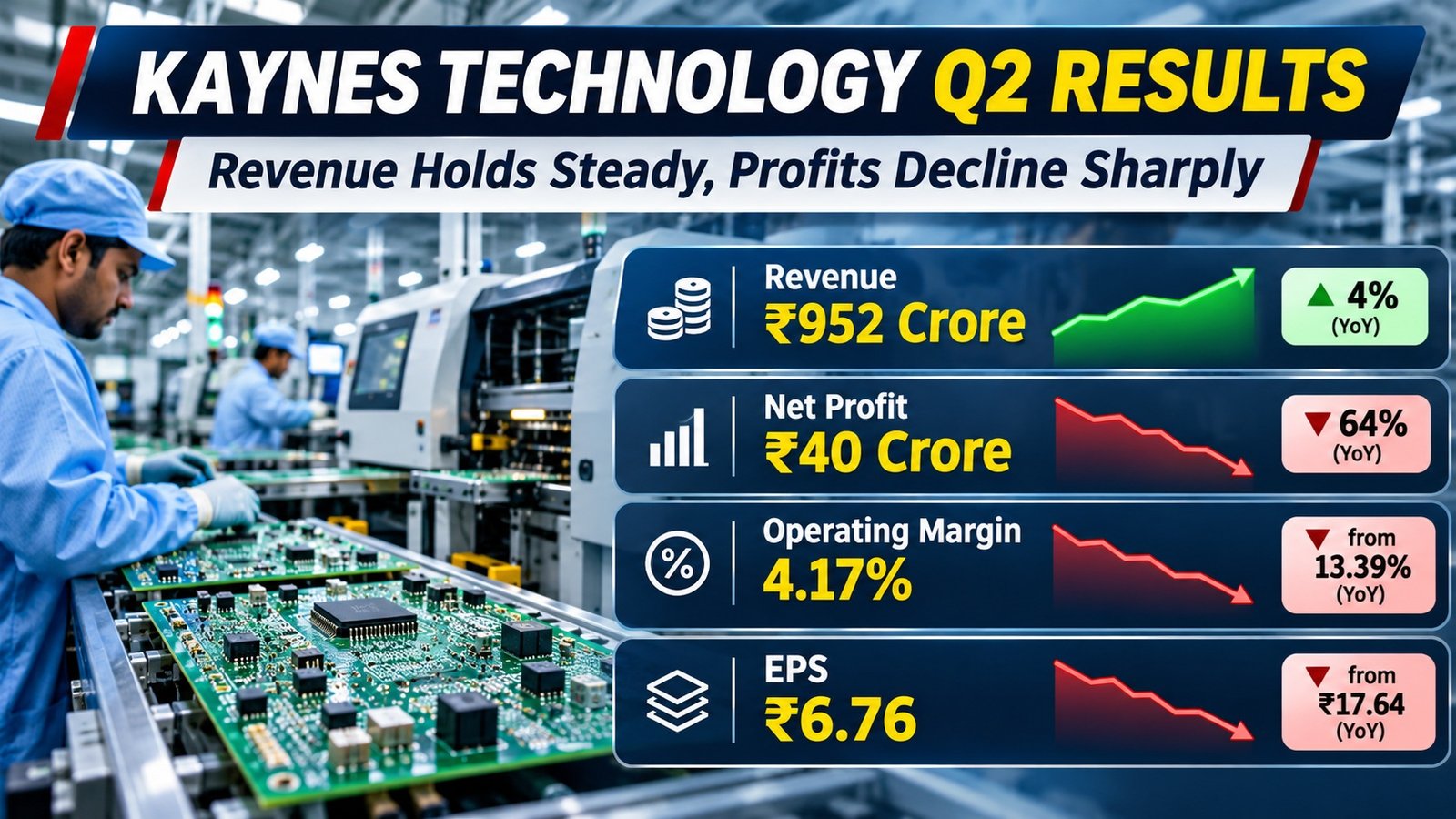
Kaynes Technology generated approximately ₹952 crore in revenue from operations during the latest quarter. This figure sits above the ₹946 crore recorded in the immediately preceding quarter and the ₹912 crore reported in the corresponding quarter of the previous year.
On a year-on-year basis the company delivered roughly 4 percent growth. Sequential movement remained almost flat, with only about 0.5 percent expansion from the prior quarter. For an EMS player, analysts typically place greater weight on annual comparisons because quarterly fluctuations can reflect order timing, project mix, and capacity utilization rather than structural changes in demand.
Market consensus heading into the results clustered around ₹880–900 crore. By clearing the upper end of that range, Kaynes delivered a modest beat on the top line. The company continues to operate in a competitive electronics manufacturing services landscape where volume growth and customer diversification remain critical. The 4 percent annual increase suggests the order book is holding up, even if the pace of expansion appears measured rather than explosive.
Revenue stability matters for EMS businesses because fixed costs related to factories, skilled labor, and quality systems are significant. When top-line growth stays positive, management gains breathing room to absorb temporary cost pressures. In this quarter that breathing room proved limited, as the expense line rose faster than sales.
Rising Operating Expenses Pressure Kaynes Technology Profitability
Expenses climbed noticeably. The company spent close to ₹900 crore in the latest quarter, up from ₹881 crore in the previous quarter and roughly ₹795 crore in the year-ago period. The increase in absolute costs outpaced the modest revenue gain and became the primary reason profitability weakened.
Higher input costs, elevated employee expenses, or increased spending on capacity and compliance can all contribute to such a jump. Market participants had already anticipated elevated costs for the period, so the higher expense base did not come as a complete surprise. Still, the magnitude of the rise left little room for operating leverage to flow through to the bottom line.
In the EMS sector, cost control often separates stronger performers from the rest of the pack. Companies that successfully pass through raw-material inflation, optimize plant utilization, and keep overhead growth in check tend to protect margins even when revenue growth moderates. Kaynes faced the opposite dynamic this quarter: revenue inched higher while the cost base expanded more aggressively.
Kaynes Technology Net Profit Declines Year-on-Year and Sequentially
Net profit came in near ₹40 crore. That compares with ₹45 crore in the preceding quarter and ₹115 crore in the same quarter last year. The year-on-year drop works out to approximately 64 percent, while the sequential decline stands at roughly 12 percent.
Market estimates had centered on a profit range of ₹50–60 crore. The actual figure landed below that band, confirming a miss on the bottom line. The profit contraction stands in contrast to the modest revenue beat and underscores how sensitive earnings remain to cost inflation and operating leverage in the current environment.
Profitability metrics matter because they influence free cash flow, return ratios, and the company’s ability to fund growth without excessive dilution or leverage. A sharp drop in absolute profit, even when revenue holds up, can prompt investors to reassess near-term earnings visibility.
Margin Compression Remains a Key Concern for Kaynes Technology
Operating margins tightened further. Last year the company reported a margin near 13.39 percent. In the previous quarter the figure stood at approximately 5.96 percent. The latest reading slipped to around 4.17 percent.
The compression from the mid-teens to the low single digits over the span of a year signals meaningful pressure on pricing power, cost absorption, or both. EMS businesses typically operate on relatively thin margins compared with high-value product companies, so even modest cost overruns or unfavorable product mix shifts can move the needle quickly.
Sustained margin recovery usually requires a combination of better capacity utilization, favorable commodity trends, improved product mix toward higher-value assemblies, and disciplined overhead management. Until those levers begin to work in the company’s favor, profitability is likely to remain under scrutiny.
Earnings Per Share Reflects the Profit Decline
Earnings per share tracked the profit trajectory lower. The latest quarter produced an EPS of roughly ₹6.76. That compares with ₹7.62 in the prior quarter and ₹17.64 in the year-ago period. The sharp year-on-year contraction in EPS mirrors the 64 percent drop in absolute profit and reinforces the message that earnings power has moderated meaningfully from last year’s levels.
For investors focused on valuation multiples, a lower EPS base can alter the earnings trajectory that underpins forward price-to-earnings ratios. Companies that deliver consistent EPS growth tend to command premium multiples; periods of contraction often lead to multiple compression until visibility improves.
Other Income Provides Partial Context for the Profit Miss
Other income ran lower than the year-ago quarter by approximately ₹16 crore. Had that differential not existed, reported profit would have landed closer to the market’s expected range of ₹50–60 crore. The shortfall in other income therefore explains a meaningful portion of the gap between consensus and actual results.
Other income can include interest on deposits, foreign-exchange gains or losses, and miscellaneous non-operating items. Its volatility means it is rarely treated as a core earnings driver, yet in quarters where operating profit is already under pressure, swings in other income can amplify or mute the overall profit print. In this case the lower contribution added to the downside surprise.
Stock Liquidity and F&O Status Shape Near-Term Trading Dynamics
Kaynes Technology shares have remained under the F&O ban for an extended period. The ban began early in the previous month and has continued, limiting participation by retail derivatives traders. As a result, price discovery currently rests more heavily with institutional investors and cash-market participants who already hold positions.
When a stock sits in the ban, short-term speculative flows diminish. Large players who established short positions earlier may continue to influence sentiment, particularly around results reactions. Monday’s market response will therefore offer an early read on how institutional holders interpret the combination of a revenue beat and a profit miss.
Liquidity conditions also affect how quickly any reassessment of the investment case translates into price movement. Stocks with restricted derivatives activity sometimes exhibit sharper moves once the ban lifts, as pent-up positioning is allowed to express itself.
Broader Context for Electronics Manufacturing Services Companies
Kaynes operates in the electronics manufacturing services space, where demand is tied to automotive electronics, industrial controls, consumer devices, and emerging areas such as electric vehicles and renewable-energy systems. Industry growth rates can vary with global supply-chain trends, domestic production-linked incentive schemes, and the pace of electronics localization in India.
A 4 percent year-on-year revenue increase sits below the higher double-digit growth rates some peers have reported in stronger demand environments. At the same time, the ability to clear consensus revenue estimates indicates that customer programs remain active. The challenge lies in converting that top-line stability into improved profitability.
Cost inflation in skilled labor, specialized components, and energy can erode margins if not offset by scale or pricing adjustments. Companies that invest ahead of demand sometimes absorb higher fixed costs in the short term with the expectation of better absorption later. Whether Kaynes is in such a transitional phase will become clearer in subsequent quarters as utilization rates and order-book conversion evolve.
Key Takeaways from Kaynes Technology Latest Quarterly Numbers
Revenue of ₹952 crore delivered a modest year-on-year gain and a small sequential improvement while beating the market’s revenue range. Expenses rose faster than sales, pushing net profit down to approximately ₹40 crore—well below both the prior-year figure and consensus expectations. Margins compressed to roughly 4.17 percent, and EPS declined in line with the profit drop. A shortfall in other income of about ₹16 crore accounted for part of the earnings miss relative to estimates.
The results highlight the sensitivity of EMS profitability to cost dynamics even when revenue holds steady. Investors will watch subsequent quarters for evidence that expense growth is moderating and that operating leverage is beginning to reappear. Until then, the focus remains on how management balances growth investments with margin protection.
The F&O ban continues to limit retail derivatives activity, leaving institutional positioning as the primary near-term driver of price action. Market reaction in the sessions following the results will provide an initial gauge of whether the revenue beat is sufficient to offset concerns around profitability.
Kaynes Technology’s latest quarter underscores a familiar theme in manufacturing businesses: top-line resilience is necessary but not always sufficient. Cost discipline and margin recovery will determine whether the company can convert steady demand into improving earnings power in the periods ahead
