

 By
Vedanta Group stocks remained under pressure on November 23, 2026, as selling intensified across the Indian stock market. The weakness was visible in several listed companies connected with the group, including Vedanta Limited, Vedanta Aluminium Metal, Vedanta Power, Vedanta Oil and Gas, and Vedanta Iron and Steel.
The decline came amid broader market weakness, profit booking and concerns about falling global metal prices. Copper, zinc and steel prices have corrected significantly, creating uncertainty for companies that depend on selling metals and other commodities. This has raised questions about the earnings outlook for major metal producers, including Vedanta and Hindustan Zinc.
However, the latest developments are not entirely negative. The aluminium industry has approached the government for zero basic customs duty on imported primary aluminium in the Union Budget 2027–28. If the proposal is accepted, it could influence raw-material costs and the competitiveness of downstream aluminium manufacturers. Vedanta Power has also reportedly launched an initiative in Punjab to encourage farmers to convert agricultural stubble into useful biomass fuel rather than burning it.
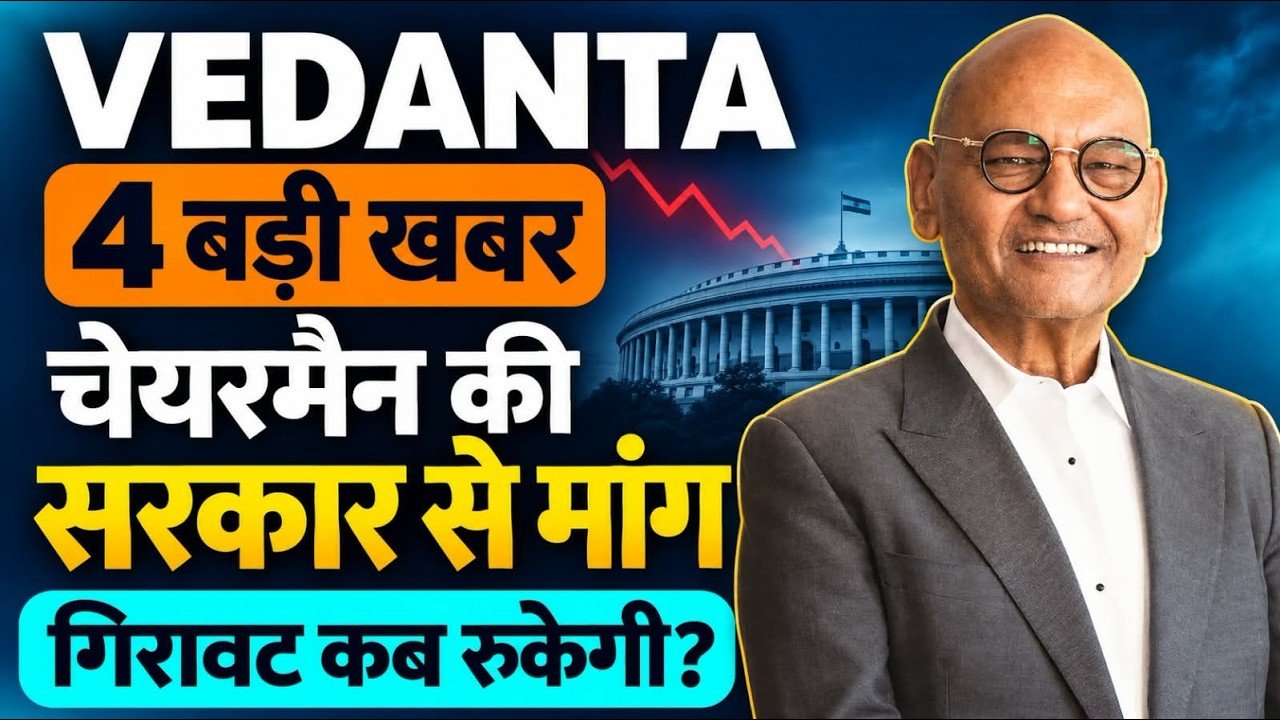
Another important development is Vedanta Chairman Anil Agarwal’s reported call for greater private-sector participation in mineral exploration, including iron ore.
In this article, we examine the latest Vedanta share price movement, Systematix’s assessment of metal-sector risks, the aluminium industry’s budget demand, Vedanta Power’s Punjab initiative and the broader outlook for the group.
Vedanta Share Price Today: Group Stocks Under Selling Pressure
The November 23 trading session was challenging for several Vedanta Group companies. Although some stocks opened on a positive or relatively stable note, selling pressure increased as the broader market weakened.
The following figures reflect the prices and movements reported for the session. Minor differences may appear across market-data providers because of exchange, closing-time and data-display variations.
| Vedanta Group stock | Reported closing price | Reported change |
|---|---|---|
| Vedanta Limited | ₹235 | -1.05% |
| Vedanta Aluminium Metal | ₹361 | -1.18% |
| Vedanta Power | ₹33.50 | -3.46% |
| Vedanta Oil and Gas | ₹29.17 | -0.69% |
| Vedanta Iron and Steel | ₹23.30 | -2.43% |
The declines indicate that the selling pressure was not limited to one company. Different businesses within the group faced weakness, although the percentage fall varied across stocks.
1. Vedanta Limited Share Price
Vedanta Limited reportedly closed at approximately ₹235 on November 23, recording a decline of around 1.05%.
The stock began the session on a relatively positive note but failed to maintain its early strength. As selling pressure increased, the share price moved lower and touched an intraday low in the ₹233 region.
The broader weakness in metal stocks was an important factor affecting sentiment. Investors were also assessing the impact of lower global commodity prices on the earnings outlook of metal producers.
Vedanta has exposure to several natural-resource businesses, so changes in commodity prices can influence its revenue expectations, operating margins and market valuation. However, the effect of a commodity-price correction depends on the individual business, production costs, sales mix and other operating factors.
Investors should therefore avoid assuming that every decline in metal prices will have the same effect on every Vedanta business.
2. Vedanta Aluminium Metal Share Price
Vedanta Aluminium Metal reportedly closed around ₹361, declining approximately 1.18% during the session.
The stock opened relatively flat and moved towards an intraday high near ₹369 before reversing as market sentiment weakened. It subsequently approached the ₹355–₹356 region.
The stock’s recent correction has attracted attention because its reported 52-week trading range included a high near ₹537 and a low around ₹334. The share price therefore remained significantly below its earlier peak.
The aluminium business is particularly relevant to the latest budget-related development. Aluminium product manufacturers have requested the government to reduce the basic customs duty on imported primary aluminium to zero.
Although the request is directed towards reducing input costs for downstream manufacturers, the broader aluminium industry could be affected by any change in import-duty policy. The actual impact on Vedanta Aluminium Metal would depend on its procurement structure, domestic sales, export exposure and the final government decision.
3. Vedanta Power Share Price
Vedanta Power was among the weaker performers in the group during the November 23 session.
The stock reportedly closed at ₹33.50, declining around 3.46%. It moved towards an intraday high near ₹35.25 before falling to approximately ₹33.43.
The decline reflected the broader selling pressure in the market. Investors should also distinguish between short-term share-price movements and developments in the company’s operating business.
One development highlighted in the latest discussion is Vedanta Power’s reported initiative in Punjab to encourage the use of agricultural residue as biomass fuel. The initiative aims to connect farmers with an alternative use for crop stubble and support the availability of biomass for industrial energy requirements.
This development is relevant to discussions about agricultural waste management, renewable energy and pollution reduction. However, the long-term financial contribution of such a programme will depend on implementation, farmer participation, biomass collection infrastructure and commercial viability.
4. Vedanta Oil and Gas Share Price
Vedanta Oil and Gas reportedly closed at ₹29.17, recording a relatively smaller decline of approximately 0.69%.
The stock traded around the ₹28.68–₹29.58 range during the session, according to the reported historical market data.
Although the decline was smaller than that of some other group companies, the stock remained below its earlier high near ₹47.60.
Oil and gas businesses have a different set of operating drivers from aluminium, zinc and steel producers. Crude-oil prices, production volumes, costs, regulatory developments and capital expenditure can all influence their performance.
Therefore, investors should evaluate Vedanta Oil and Gas separately rather than treating every group company as having identical business risks.
5. Vedanta Iron and Steel Share Price
Vedanta Iron and Steel reportedly closed at approximately ₹23.30, down around 2.43%.
The stock initially moved towards ₹24 before losing ground as market selling increased. Its movement reflected the pressure across the metal sector.
Steel producers can be affected by changes in raw-material costs, finished-steel prices, domestic demand, export conditions and competition from international suppliers.
The latest weakness in global metal prices has therefore increased the importance of monitoring commodity trends and the company’s operating performance.
Systematix Report on Metal Stocks: Why Is Vedanta Facing Earnings Risk?
One of the most important developments discussed in the latest Vedanta market update is a report from Systematix Institutional Equities on the impact of falling metal prices.
The report highlights a difference between companies that produce metals and businesses that use metals as raw materials.
When copper, zinc and steel prices decline, metal producers may face lower selling prices and pressure on their earnings. At the same time, companies that purchase these materials for manufacturing may benefit from lower input costs.
This distinction is important for understanding why a fall in commodity prices can be negative for one group of companies but positive for another.
Copper, Zinc and Steel Prices Have Corrected
According to the Systematix report discussed on November 23, global prices of key industrial metals had experienced a significant correction.
The reported declines were:
- Copper: approximately 16%.
- Zinc: approximately 21%.
- Steel: approximately 5%.
These figures indicate the scale of the correction discussed in the report. They should be understood in the context of the report’s measurement period rather than as permanent changes in commodity prices.
A sustained decline in selling prices can affect metal producers because their revenue is linked to the prices they receive for their output.
The final effect on earnings, however, also depends on production costs, operating efficiency, inventory valuation, contracts and the company’s ability to manage expenses.
Why Falling Metal Prices Can Hurt Vedanta
Vedanta has exposure to businesses connected with metals and natural resources. A prolonged decline in relevant commodity prices can create pressure on revenue and profitability.
For example, lower zinc prices may affect the earnings outlook of zinc producers. Similarly, changes in aluminium and other commodity prices can influence the financial performance of businesses exposed to those markets.
The Systematix assessment reportedly identified Vedanta, Hindustan Zinc and Hindustan Copper among the companies facing earnings risks from the correction in metal prices.
This does not mean that these companies will necessarily report lower profits in every quarter. It means their earnings expectations may become more vulnerable if commodity prices remain weak.
Investors should monitor the relationship between realised selling prices and production costs rather than looking at commodity prices alone.
Why Metal-Using Companies May Benefit
The other side of the correction involves companies that purchase metals for manufacturing.
Consumer-durable manufacturers and automobile companies use materials such as copper, steel and aluminium in their products. Lower raw-material prices can reduce manufacturing costs if companies are able to purchase inputs at more favourable rates.
Potential benefits include:
- Lower raw-material expenses.
- Improved operating margins.
- Greater flexibility in pricing finished products.
- Better profitability if product demand remains stable.
- Improved earnings visibility when input costs decline consistently.
However, these benefits are not automatic. Manufacturers may face weak demand, competitive pricing, higher expenses in other areas or delays before lower commodity prices appear in their purchasing costs.
Systematix reportedly preferred consumer durables, followed by automobiles, while remaining cautious on metal producers.
Systematix’s Preferred Stocks and Companies Facing Risk
The report discussed several companies across consumer durables, automobiles and metals.
Consumer Durable Stocks Highlighted by Systematix
The consumer-durable companies identified as preferred names included:
- Voltas
- Blue Star
- Havells India
- Crompton Greaves Consumer
These businesses use industrial materials in products such as air conditioners, cooling equipment, electrical appliances and other consumer products.
If metal prices remain lower, manufacturers may have an opportunity to reduce input costs. The actual benefit will depend on procurement contracts, inventory levels, selling prices and competition.
The report’s positive view on consumer durables was also linked to the sector’s relative valuation and sensitivity to changes in commodity costs.
Automobile Stocks Highlighted by Systematix
The automobile companies mentioned in the report included:
- Bajaj Auto
- TVS Motor
- Eicher Motors
- Hyundai Motor India
- Tata Motors
The report indicated that two-wheeler manufacturers could be among the beneficiaries because of their exposure to aluminium and copper.
Lower metal prices can support manufacturing margins, especially when companies maintain stable selling prices and manage other operating expenses.
Nevertheless, automobile stocks are also influenced by vehicle demand, financing costs, competition, product launches and regulatory changes. A fall in raw-material prices alone is not sufficient to determine the future performance of an automobile company.
Metal Producers Identified as Higher-Risk Names
The report highlighted the following companies as exposed to risks from lower metal prices:
- Vedanta
- Hindustan Zinc
- Hindustan Copper
The concern is that lower commodity prices could affect realised revenue and earnings expectations.
For Vedanta investors, this is an important development because the stock’s performance is connected to both company-specific developments and the wider commodity cycle.
A recovery in metal prices could improve sentiment, but investors should not assume that a rebound will happen immediately.
Why Are Global Metal Prices Falling?
The correction in global metal prices has been linked to several macroeconomic and industrial factors.
1. Weakening Global Industrial Demand
Industrial metals are closely connected to manufacturing, construction, infrastructure and other economic activities.
When industrial demand weakens, buyers may reduce purchases or delay orders. This can affect commodity prices, especially when inventories are also increasing.
Concerns about the pace of global economic growth have therefore contributed to uncertainty across metal markets.
2. China’s Industrial Activity
China is an important participant in global metal markets because of its large manufacturing, construction and industrial sectors.
Weakness in Chinese industrial activity can influence demand expectations for metals such as copper, zinc and steel.
The Systematix report referred to softer Chinese industrial indicators, weaker fixed-asset investment conditions and lower crude-steel output as factors affecting sentiment.
If China’s industrial demand remains subdued, the global metal market could face continued pressure.
3. Stronger US Dollar
The US dollar is another important factor influencing internationally traded commodities.
Many metals are priced in US dollars. When the dollar strengthens, commodities can become more expensive for buyers using other currencies.
This can affect demand and influence investor sentiment in commodity markets.
4. US Inflation and Federal Reserve Expectations
Inflation data and comments from the US Federal Reserve can influence expectations about interest rates.
If investors expect interest rates to remain higher for longer, the dollar and bond yields may remain supported. This can create pressure on commodities and other risk-sensitive assets.
Market participants therefore monitor US inflation, Federal Reserve communication and global financial conditions when assessing metal-price movements.
5. Profit Booking After a Strong Rally
Commodity prices do not move in one direction indefinitely.
After a substantial rally, investors and traders may book profits. When this happens alongside weaker demand indicators or rising inventories, the correction can become sharper.
Systematix linked the recent metal-price weakness to macroeconomic pressure, softer industrial demand, rising inventories and profit booking after a strong rally.
Aluminium Industry Requests Zero Import Duty in Union Budget 2027–28
Another major development is the request made by aluminium product manufacturers to the government ahead of the Union Budget 2027–28.
The Aluminium Extrusion Manufacturers Association of India (ALEMAI) has reportedly requested that the basic customs duty on imported primary aluminium be reduced from 7.5% to zero.
The association has argued that the existing duty structure increases raw-material costs for downstream aluminium manufacturers, particularly small and medium-sized businesses.
What Is the Current Import Duty?
The reported duty structure includes:
- Basic customs duty: 7.5%.
- Social welfare surcharge: 10% of the basic customs duty.
- Effective import duty: approximately 8.25%.
The distinction between the basic customs duty and the effective duty is important.
The industry’s request is to remove the 7.5% basic customs duty on primary aluminium. Because the surcharge is calculated on the basic duty, the effective burden is approximately 8.25%.
Why Does the Aluminium Industry Want Duty Relief?
Downstream aluminium manufacturers use primary aluminium as a raw material to produce finished and semi-finished products.
These products are used in construction, electrical equipment, transportation, engineering and several other industries.
When imported raw materials attract customs duties, the cost of procurement can increase. Manufacturers argue that this can make their products less competitive, particularly when they compete with suppliers operating under different cost structures.
The association has highlighted the pressure on micro, small and medium enterprises.
Its proposal is intended to:
- Reduce the cost of primary aluminium procurement.
- Improve the competitiveness of downstream manufacturers.
- Support domestic value addition.
- Improve export competitiveness.
- Encourage wider aluminium consumption.
- Provide relief to smaller manufacturing businesses.
The request has been made ahead of the government’s budget process. It is a proposal, not an announced policy change.
Could Zero Import Duty Benefit Vedanta?
The possible impact on Vedanta requires careful analysis.
Vedanta is a major participant in India’s aluminium industry. However, the proposal is primarily aimed at reducing input costs for downstream aluminium product manufacturers.
If the government accepts the request, downstream manufacturers could receive relief through lower import-related costs, depending on market pricing and supply conditions.
For primary aluminium producers, the effect could be more complicated. Changes in import duties may influence domestic price benchmarks, competition and the economics of different parts of the aluminium value chain.
Therefore, it would be incorrect to conclude that removing the duty will automatically increase Vedanta’s profits.
The actual impact will depend on the final policy, domestic aluminium prices, production costs, import volumes and the company’s sales mix.
Investors should wait for the government’s decision and any company-specific disclosures before drawing conclusions.
Vedanta Power Launches Punjab Campaign to Turn Crop Stubble into Energy
The latest discussion also highlighted a reported initiative by Vedanta Power in Punjab.
The campaign, described as encouraging farmers to turn agricultural stubble into a source of power, aims to promote the use of crop residue as biomass fuel.
The central idea is to provide an alternative to burning agricultural waste in fields.
Why Is Crop Stubble Burning a Concern?
After harvesting crops, farmers may be left with substantial quantities of agricultural residue.
In some areas, this residue is burned to clear fields quickly before the next crop cycle. However, stubble burning contributes to air pollution and can affect air quality across neighbouring regions.
The issue is particularly important in northern India, where seasonal pollution has become a major public concern.
An alternative approach is to collect and process crop residue for use as biomass fuel.
How Can Biomass Help?
Agricultural residue can be processed into biomass-based fuel products, including pellets.
These products can be used in certain industrial and energy applications, subject to technical requirements and fuel specifications.
A biomass programme can potentially create benefits for different participants:
For farmers: Crop residue may become a saleable resource rather than waste that needs to be burned or disposed of.
For energy companies: Biomass can provide an alternative fuel source when it meets the company’s operational and technical requirements.
For the environment: Greater use of agricultural residue may help reduce open-field burning and its associated pollution.
For local communities: Collection, transportation and processing activities may create additional economic opportunities.
What Could the Initiative Mean for Vedanta Power?
For Vedanta Power, the initiative could support its efforts to explore alternative fuel sources and engage with agricultural communities.
However, the long-term business impact will depend on practical implementation.
Important factors include the availability of crop residue, collection costs, storage facilities, transportation arrangements, processing capacity and the commercial price of biomass fuel.
The initiative should therefore be viewed as a sustainability and operational development rather than immediate evidence of higher profits.
Its financial contribution will become clearer only when the company provides information about the scale of implementation and the quantity of biomass used.
Anil Agarwal Calls for Greater Private Participation in Mineral Exploration
Another development highlighted in the transcript concerns Vedanta Chairman Anil Agarwal’s reported comments on mineral exploration.
The central message is that the government should encourage greater participation from private companies alongside public-sector enterprises.
The proposal is aimed at increasing exploration activity and attracting more investment and technology into India’s mineral sector.
Why Is Private Participation Important?
Mineral exploration requires capital, technical expertise, modern equipment and long-term planning.
A wider group of participants could potentially help increase exploration activity and improve the identification of mineral resources.
Private-sector involvement may also support:
- Investment in exploration technology.
- Faster development of exploration projects.
- Greater technical capabilities.
- New business opportunities for specialised companies.
- Better use of domestic mineral resources.
Iron ore and other minerals are important inputs for industrial development. Increasing domestic exploration could support supply security and reduce dependence on imports for certain resources.
However, exploration is a long-term process. Discovering a mineral resource does not automatically mean that a commercially viable mine can be developed.
Regulatory approvals, environmental clearances, infrastructure, land access, investment requirements and market conditions all influence project development.
What Could This Mean for Vedanta?
Vedanta operates in the natural-resources and metals sector. A policy environment that encourages investment in mineral exploration could create opportunities for companies with relevant technical and financial capabilities.
However, the potential benefits should not be treated as guaranteed future revenue.
Investors should monitor government policy changes, exploration permissions, project announcements and the company’s actual investment commitments.
Vedanta Group Share Price Outlook: Key Factors to Monitor
The recent correction has raised questions about whether Vedanta Group stocks can recover.
There are both supportive developments and risks to consider.
Factors That Could Support a Recovery
1. Improvement in global metal prices
A recovery in copper, zinc, aluminium and steel prices could improve sentiment towards metal producers. The actual effect would depend on the commodities relevant to each business.
2. Better industrial demand
Stronger manufacturing and construction activity could improve demand expectations for industrial metals.
3. Policy support for the aluminium sector
Any government decision on the aluminium industry’s customs-duty request could influence the economics of downstream manufacturers and the broader aluminium market.
4. Greater mineral exploration activity
Policies encouraging private investment in exploration could create long-term opportunities across the natural-resources sector.
5. Progress in biomass initiatives
If Vedanta Power successfully expands its biomass programme, it could support fuel diversification and sustainability-related objectives.
Risks That Investors Should Not Ignore
1. Continued weakness in commodity prices
If global metal prices remain under pressure, earnings expectations for producers may face further challenges.
2. Weak global industrial demand
A slowdown in major industrial economies could affect demand for metals and other commodities.
3. Currency and interest-rate movements
A stronger US dollar and changing global interest-rate expectations can influence commodity prices and investor sentiment.
4. Market-wide volatility
Even companies with positive business developments can experience share-price declines during broad market corrections.
5. Differences between group companies
Vedanta Limited, Vedanta Aluminium Metal, Vedanta Power, Vedanta Oil and Gas, and Vedanta Iron and Steel have different business models and financial drivers. Their share prices should not be evaluated as though they represent one identical business.
What Should Investors Track Before Evaluating Vedanta Shares?
Investors following Vedanta Group stocks should focus on business fundamentals rather than relying only on daily price movements.
Some important indicators include:
- International prices of aluminium, zinc, copper and steel.
- Production volumes and realised selling prices.
- Operating costs and margins.
- Quarterly revenue and profit trends.
- Debt levels and financing expenses.
- Capital expenditure and expansion plans.
- Government policy changes affecting the metals industry.
- Management commentary and official stock-exchange disclosures.
- Developments in global industrial demand.
It is also important to compare each company’s valuation with its earnings outlook and financial position.
A lower share price does not automatically mean a stock is undervalued. Similarly, a sharp fall does not necessarily mean that a company’s long-term business prospects have permanently deteriorated.
Conclusion: Can Vedanta Group Stocks Recover After the Recent Fall?
Vedanta Group stocks faced selling pressure on November 23, 2026, as the Indian market corrected and global metal prices remained weak.
The Systematix report added to concerns about earnings risks for metal producers, including Vedanta, Hindustan Zinc and Hindustan Copper. At the same time, the report highlighted the possibility that lower raw-material costs could benefit selected consumer-durable and automobile companies.
The aluminium industry’s request for zero basic customs duty on primary aluminium is another development worth monitoring ahead of the Union Budget 2027–28. However, the request has not yet become government policy, and its impact on individual companies will depend on the final decision.
Vedanta Power’s reported Punjab biomass campaign and Anil Agarwal’s call for greater private-sector participation in mineral exploration provide additional developments beyond daily share-price movements.
For investors, the most important task is to separate short-term market sentiment from long-term business performance. Commodity prices, production costs, financial results, policy decisions and company disclosures will remain important factors in evaluating the group’s future prospects.
The recent correction may attract attention, but investors should conduct independent research and assess the risks of each company before making any investment decision.
Frequently Asked Questions (FAQs)
1. Why are Vedanta Group shares falling in November 2026?
Vedanta Group shares have faced pressure amid a broader market correction, profit booking and weakness in global metal prices. Systematix has also highlighted earnings risks for metal producers such as Vedanta, Hindustan Zinc and Hindustan Copper.
2. What did Systematix say about Vedanta shares?
Systematix reportedly cautioned that falling copper, zinc and steel prices could create earnings risks for metal producers. Vedanta, Hindustan Zinc and Hindustan Copper were among the companies identified as exposed to this pressure.
3. Why has the aluminium industry requested zero import duty?
The Aluminium Extrusion Manufacturers Association of India has reportedly requested that the basic customs duty on imported primary aluminium be reduced from 7.5% to zero. The industry says lower input costs could support downstream manufacturers, MSMEs and export competitiveness.
4. Could the aluminium import-duty proposal benefit Vedanta?
The proposal could influence costs and competition across the aluminium value chain. However, it is primarily aimed at downstream manufacturers that use primary aluminium as a raw material. Its effect on Vedanta will depend on the final policy and market conditions.
5. What is Vedanta Power’s Punjab stubble campaign?
The reported campaign encourages farmers to use agricultural residue as a biomass resource rather than burning it in fields. The initiative aims to support alternative fuel use and reduce pollution associated with stubble burning.
6. What did Anil Agarwal say about mineral exploration?
The Vedanta Chairman reportedly called for greater private-sector participation alongside public-sector companies in mineral exploration. The objective is to encourage investment, technology and exploration activity in India’s mineral sector.
7. Is the recent fall in Vedanta shares a buying opportunity?
A share-price correction alone does not establish that a stock is undervalued. Investors should examine commodity-price trends, earnings, debt, cash flows, valuations and company-specific developments before making a decision. No recovery is guaranteed.
SEO Keywords
Primary keyword: Vedanta share news today
Secondary keywords:
- Vedanta share price today
- Vedanta Group latest news
- Vedanta stock latest update
- Vedanta Aluminium Metal share price
- Vedanta Power share price
- Vedanta metal stocks
- Systematix report on metal stocks
- Aluminium import duty India
- Union Budget 2027–28 aluminium industry
- Vedanta share price outlook 2026
- Hindustan Zinc share news
- Global metal price crash
- Vedanta Power Punjab biomass campaign
Suggested URL Slug: vedanta-share-news-today-metal-price-crash-systematix-report-aluminium-duty-2026
Meta Description: Vedanta share news today: Explore the November 23, 2026, stock decline, Systematix’s metal-sector warning, aluminium industry’s zero-duty demand, Vedanta Power’s Punjab biomass campaign and the latest group updates.