
 By
The Supreme Court of India has passed a significant order in the Thiruparankundram Karthigai Deepam dispute, directing that the ceremonial lamp be lit at the Deepathoon stone pillar on Thiruparankundram Hill in Madurai on Saturday, November 28, 2026.
The order came after the court examined allegations that its earlier direction permitting the lighting of the lamp had not been implemented on November 24.
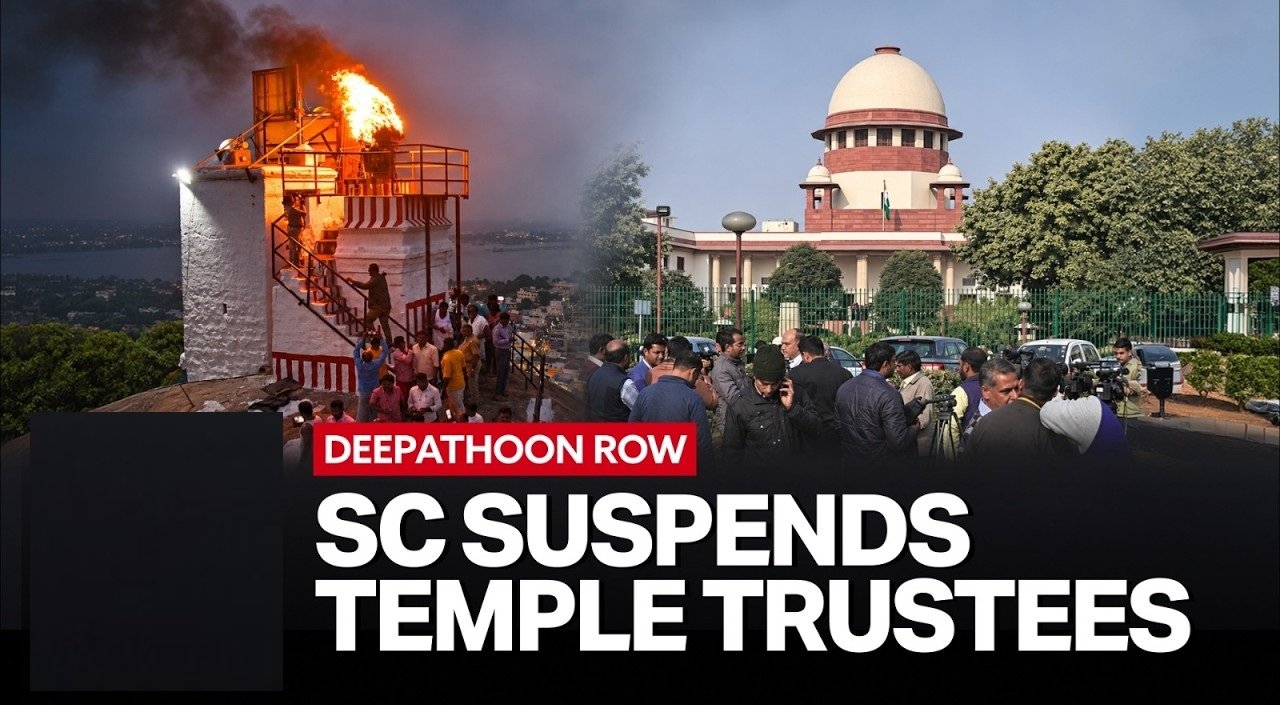
Taking a strong view of the alleged non-compliance, the Supreme Court issued contempt notices to senior Tamil Nadu officials and temple authorities. It also suspended the Board of Trustees of the Arulmigu Subramaniya Swamy Temple and appointed two former Madras High Court judges as receivers to oversee the temple’s administration and ensure that the latest directions are carried out.
The court has further directed the Central Reserve Police Force (CRPF) to provide security to the temple and the nearby Sikandar Dargah.
The development is a major turning point in the ongoing Thiruparankundram Deepathoon controversy, which has involved religious traditions, temple administration, public order and the implementation of judicial directions.
Supreme Court Orders Karthigai Deepam at Deepathoon on November 28
The Supreme Court has directed that the Karthigai Deepam lamp be lit at the Deepathoon on Thiruparankundram Hill on November 28.
The court said the lamp should be lit using the flame from the Uchipillaiyar Mandapam, provided that the flame is still burning. If that is not possible, the authorities may make another suitable arrangement.
The direction follows the court’s earlier order permitting the ceremonial lighting of the lamp at the disputed stone pillar.
The latest order makes clear that the ceremony must be carried out without further delay.
The Supreme Court has also permitted devotees to light the lamp at the Deepathoon, subject to the conditions specified by the court.
Devotees allowed to light lamps at least 50 metres from the Dargah
One of the important directions concerns the distance between the lamp-lighting location and the Sikandar Dargah on the hill.
The Supreme Court has directed that devotees be allowed to light the lamp at a distance of at least 50 metres from the Dargah on all sides.
The court has also instructed the CRPF to ensure the protection of the Dargah and its premises.
This condition is intended to allow the religious ceremony to take place while maintaining security and preventing disturbances at the hilltop.
Supreme Court Flags Prima Facie Violation of Earlier Order
The Supreme Court expressed serious concern over the failure to implement its November 20 direction.
The earlier order had permitted the lighting of the Karthigai Deepam at the Deepathoon on November 24. However, the lamp was not lit at the disputed pillar on that date.
During the hearing on November 27, the court examined the explanations submitted by the Madurai district administration and the temple authorities.
The bench observed that the circumstances appeared to disclose wilful and flagrant disobedience of its earlier order.
The court also criticised the administrative response and expressed concern about the manner in which officials had handled the matter.
Court says its orders cannot be treated as optional
The Supreme Court emphasised that an order passed by the court is binding on the state government, its officials and institutions functioning under the relevant law.
The bench observed that a judicial order cannot be treated as an invitation to negotiate or selectively implement.
The court warned that failure to comply with judicial directions could undermine the rule of law and lead to constitutional chaos.
It also said that the situation required a firm response to ensure that constitutional authority was respected.
These observations reflect the court’s concern about the implementation of its previous order. They do not, by themselves, amount to a final finding of contempt against every official who has received notice.
Tamil Nadu Chief Secretary Asked to Appear Personally
The Supreme Court has issued contempt notices to senior Tamil Nadu officials, including the Chief Secretary and the Director General of Police.
The notices also cover other officials connected with the administration of the Deepathoon issue, including the Madurai District Collector, police officials, the Hindu Religious and Charitable Endowments Department and temple authorities.
The court has directed the Tamil Nadu Chief Secretary to appear personally before it on December 15, 2026.
The Chief Secretary has also been directed to provide details of communications exchanged between officials in connection with the implementation of the court’s earlier order.
The requested information includes relevant emails, telephone calls and messages.
The purpose is to examine how the decision not to carry out the lamp-lighting direction was reached and whether any officials failed to discharge their responsibilities.
Contempt notices issued to officials
The Supreme Court’s contempt notices require the concerned officials to explain why proceedings should not be initiated against them for alleged non-compliance.
The court is examining whether the failure to light the lamp at the Deepathoon amounted to wilful disobedience of its November 20 order.
It is important to distinguish between a contempt notice and a final conviction.
A contempt notice gives the concerned person an opportunity to respond to the allegations. The court will consider the explanations and evidence before deciding whether further action is warranted.
Temple Board of Trustees Suspended by Supreme Court
In another major development, the Supreme Court has suspended the Board of Trustees of the Arulmigu Subramaniya Swamy Temple at Thiruparankundram.
The decision came after the court examined the role of the temple administration in the failure to carry out the earlier lamp-lighting order.
The temple board’s suspension is one of the strongest measures taken in the case so far.
The court has appointed two former Madras High Court judges as receivers to take charge of the temple’s administration and ensure compliance with the directions.
Two Former High Court Judges Appointed as Temple Receivers
The Supreme Court has appointed former judges Justice S. Vaidyanathan and Justice V. Parthiban as receivers of the temple.
The receivers have been entrusted with overseeing the temple administration and ensuring that the court’s directions are implemented.
Their responsibilities include coordinating the arrangements required for the lamp-lighting ceremony and managing the temple’s affairs in accordance with applicable laws and traditions.
The state administration has been directed to provide necessary assistance to the receivers.
The appointment is intended to ensure that the temple administration does not obstruct or delay the implementation of the Supreme Court’s order.
CRPF Directed to Secure Thiruparankundram Hill
The Supreme Court has directed the Central Reserve Police Force to provide security at Thiruparankundram Hill.
The security arrangement covers the temple, the Deepathoon area and the nearby Sikandar Dargah.
The court’s direction follows concerns about the ability of local authorities to ensure the peaceful implementation of the lamp-lighting order.
The CRPF has been tasked with maintaining security and protecting both religious sites.
The court has also emphasised that the ceremony must take place without disturbing the Dargah or its worshippers.
The security arrangements are expected to remain an important part of the implementation of the November 28 order.
What Happened on November 24?
The controversy intensified after the Karthigai Deepam lamp was not lit at the Deepathoon on November 24, despite the Supreme Court’s earlier direction.
The court had permitted the lighting of the lamp at the stone pillar on Thiruparankundram Hill.
However, the ceremony did not take place at the specified location.
During the subsequent hearing, the Archaeological Survey of India (ASI) and other parties presented their accounts of what happened.
The ASI reportedly told the court that its officials faced restrictions while attempting to proceed towards the Deepathoon.
The district administration, meanwhile, submitted a status report explaining its position and referring to the role of the temple trustees.
The Supreme Court examined these competing explanations and expressed dissatisfaction with the administrative response.
The court’s latest order is intended to ensure that the ceremony takes place as directed.
ASI’s Role in the Thiruparankundram Deepam Case
The Archaeological Survey of India has been involved in the dispute because of questions relating to the hilltop location and the implementation of the lamp-lighting order.
During the hearing, the ASI reportedly submitted that its officials had been prevented from proceeding to the Deepathoon.
The agency’s position became an important part of the proceedings as the court examined whether the earlier order had been obstructed.
The Supreme Court considered the submissions made by the ASI, the district administration and other parties before issuing its latest directions.
The court’s order has now placed responsibility for implementation under the supervision of the appointed receivers and the security arrangements directed by the bench.
Why Is the Thiruparankundram Deepathoon Dispute Significant?
Thiruparankundram Hill is an important religious site in Madurai, Tamil Nadu.
The hill is associated with the Arulmigu Subramaniya Swamy Temple and the Sikandar Dargah.
The dispute concerns the location where the traditional Karthigai Deepam lamp may be lit.
The Deepathoon is a stone pillar on the hill that has become the centre of the legal controversy.
The matter has attracted attention because it involves several issues:
- The observance of religious traditions.
- The administration of a Hindu temple.
- The relationship between the temple and nearby religious structures.
- The responsibilities of state officials in implementing court orders.
- The limits of administrative discretion when a judicial direction is in force.
- The protection of public order and religious harmony.
The Supreme Court’s latest directions address both the religious ceremony and the security arrangements required for its peaceful conduct.
Tamil Nadu Government’s Position and the Political Debate
The dispute has also become a subject of political debate in Tamil Nadu.
The state administration and temple authorities have faced criticism over the failure to implement the earlier order.
The Supreme Court’s observations about administrative chaos and possible political influence have further intensified the controversy.
However, claims about the involvement of particular political leaders or parties should be distinguished from findings formally established by the court.
The contempt proceedings will examine the conduct of the officials and institutions named in the notices.
The court’s latest order does not resolve every political allegation surrounding the case. Its immediate focus is to ensure that the lamp is lit at the Deepathoon and that its earlier directions are respected.
Is the Supreme Court’s Order a Permanent Decision?
The November 27 order directs the lamp to be lit on November 28.
The court has also taken interim administrative and security measures, including suspending the temple trustees and appointing receivers.
However, the broader legal dispute concerning the location and future observance of the Deepam remains subject to further proceedings.
The Tamil Nadu government has reportedly filed a review petition challenging the earlier decision.
The review proceedings are separate from the contempt matter heard on November 27.
The Supreme Court’s immediate direction is therefore focused on carrying out the lamp-lighting ceremony, while the broader legal questions will be considered in subsequent hearings.
What Happens Next in the Thiruparankundram Deepam Case?
The next important development is the implementation of the lamp-lighting order on November 28.
The appointed receivers will oversee the temple administration and coordinate the arrangements required to carry out the court’s directions.
The CRPF will provide security at the hill, including protection for the temple and the Dargah.
The contempt proceedings will continue, with the Chief Secretary directed to appear personally on December 15.
The court will examine the explanations submitted by the officials and determine whether further action is required.
The review petition concerning the broader dispute is expected to be considered separately.
Frequently Asked Questions
What did the Supreme Court order in the Thiruparankundram Deepam case?
The Supreme Court directed that the Karthigai Deepam lamp be lit at the Deepathoon on Thiruparankundram Hill on November 28, 2026. It also suspended the temple trustees, appointed two former judges as receivers and directed the CRPF to provide security.
When will the Deepam be lit at Thiruparankundram?
The Supreme Court has ordered the lamp to be lit on Saturday, November 28, 2026.
Why did the Supreme Court issue contempt notices?
The court issued contempt notices after finding a prima facie case of wilful and flagrant disobedience of its November 20 order permitting the lamp to be lit at the Deepathoon.
Who has been appointed as receivers of the temple?
Former Madras High Court judges Justice S. Vaidyanathan and Justice V. Parthiban have been appointed as receivers to oversee the temple administration and ensure implementation of the court’s directions.
Why has the CRPF been deployed?
The Supreme Court directed the CRPF to provide security to the temple and the nearby Sikandar Dargah and to ensure that the lamp-lighting ceremony takes place peacefully.
Has the Supreme Court made a final decision on the entire dispute?
The court has issued directions for the immediate lamp-lighting ceremony and taken interim measures regarding temple administration and security. The broader legal dispute and review proceedings remain separate matters for further consideration.
URL Slug: supreme-court-thiruparankundram-deepam-order-november-28
Meta Description: Supreme Court orders Thiruparankundram Deepam lighting on November 28, suspends temple trustees, appoints former judges as receivers and directs CRPF security.