
 By
Introduction: Why Are Railway Stocks Falling Despite Positive Market Sentiment?
Railway stocks have attracted considerable attention from investors over the past few years. Companies such as Rail Vikas Nigam Limited (RVNL), Indian Railway Finance Corporation (IRFC), and Indian Railway Catering and Tourism Corporation (IRCTC) have benefited from expectations surrounding India’s railway infrastructure expansion, modernisation projects, financing requirements, and growing passenger services.
However, recent share price movements have raised questions among investors. Even when the broader stock market shows strength, railway-related shares can experience selling pressure. This has led shareholders to examine whether the recent weakness is temporary or whether these companies are facing challenges that could affect their future performance.
The latest market discussion covers four important stocks: RVNL, IRFC, IRCTC, and Vaibhav Global. RVNL has remained below its previous highs despite reporting a substantial project pipeline and discussing its quarterly performance with investors. IRFC has also experienced a decline, although its financing business and long-term growth ambitions continue to attract attention. Meanwhile, IRCTC has reported business growth, and a brokerage report has reportedly expressed a positive view of the company’s prospects.
Another important corporate development concerns Vaibhav Global, which has announced a proposed stock split involving a change in its face value from ₹5 to ₹2. The company has also attracted attention because of its reported movement from losses to profit and changes in foreign institutional investor (FII) shareholding.
This article examines the developments discussed in the source video, including RVNL’s order book, railway joint ventures, IRCTC’s business model, IRFC’s assets under management, and Vaibhav Global’s stock split.
Editorial note: All prices, financial figures, dates, brokerage views, and corporate developments below are based on the supplied video transcript. Some figures and phrases in the transcript are unclear or internally inconsistent. They are identified as reported information and should be checked against official company announcements, stock exchange filings, financial statements, and brokerage reports before publication or investment decisions.
RVNL Share Latest News 2026: Why Did Rail Vikas Nigam Stock Decline?
Rail Vikas Nigam Limited was one of the railway-sector stocks that experienced a significant correction after its earlier rally.
According to the source video, RVNL closed at approximately ₹199.10 on Friday, recording a decline of around 2.05%. The stock remained substantially below its previous 52-week high.
The transcript provides the following price levels:
| RVNL share price detail | Figure reported in the video |
|---|---|
| Friday’s closing price | Approximately ₹199.10 |
| One-day movement | -2.05% |
| 52-week high | Approximately ₹400 |
| Earlier historical peak | Approximately ₹647 |
The transcript also recalls that RVNL had once traded around ₹30 before rising sharply to approximately ₹647 during its strong rally. That movement made the stock a major talking point among railway-sector investors.
However, the share price subsequently corrected, and investors who purchased near the higher levels may have experienced substantial losses.
Why Has RVNL Fallen From Its Previous High?
A stock’s earlier rally does not guarantee that its price will continue rising. Share prices are influenced by business performance, earnings expectations, valuations, institutional investment, market sentiment, and the availability of new orders.
RVNL’s correction should therefore be examined from multiple perspectives.
1. Profit booking after a strong rally
Stocks that rise rapidly can experience significant profit booking. Investors who purchased at lower levels may decide to sell after a substantial increase in market value.
2. Valuation expectations
When a company’s share price rises faster than its earnings, investors may begin reassessing its valuation. Even a company with a healthy project pipeline can experience a correction if the market expects more growth than the business can deliver in the short term.
3. Changing investment preferences
The source commentary suggests that investors may be concentrating their attention on other market segments. When institutional money moves towards large-cap companies, smaller and mid-cap stocks may receive less buying support.
4. Market expectations around railway spending
Railway-sector stocks are often influenced by expectations about infrastructure investment, government spending, new contracts, and project execution. Any change in expectations can affect investor sentiment.
These factors are possible explanations for price weakness. The supplied transcript does not establish one confirmed reason for RVNL’s decline.
RVNL Q2 Results: What Did Management Discuss in the Earnings Conference Call?
One of the important developments highlighted in the video is the publication of RVNL’s quarterly earnings conference-call transcript on the company’s website.
According to the source, the conference call took place on the 17th at approximately 4:00 PM. Senior management members participated and discussed the company’s quarterly performance and business developments.
The names and designations mentioned in the transcript include:
- Saleem Ahmed, Chairman and Managing Director.
- Dev Mij Anupama Ben, Director (Personnel), as transcribed in the source.
- Mrityunjay Pratap Singh, Director (Operations).
- Neeti Sarkar, Director (Finance).
- Amit Tandon, Director (Projects).
- Chandan Kumar Verma, Chief Financial Officer.
- A representative from Choice Connect Private Limited.
The publication of an earnings-call transcript is useful because it allows shareholders to understand management’s comments beyond the headline financial results.
Investors can use the transcript to examine management’s views on project execution, order inflows, business expansion, joint ventures, financial performance, and future opportunities.
However, the source video does not reproduce the complete conference-call discussion. Investors interested in the details should read the original document on RVNL’s official website.
RVNL Order Book: Why Are Investors Watching the Company’s Project Pipeline?
The source video highlights RVNL’s order book as an important part of its business outlook.
The transcript reports an order-book figure of approximately ₹99,900 crore, although the number is garbled in the supplied text and should be verified. It also mentions growth of approximately 6% and an order-book-to-FY2026-revenue multiple of around 4.1 times.
The video separately refers to railway project work worth approximately ₹5,686 crore.
Because the order-book figure is unclear, it would be inappropriate to treat ₹99,900 crore as a confirmed value without checking the company’s official presentation or earnings-call transcript.
Why Does the Order Book Matter?
An order book represents the value of contracts a company has secured but has not yet completed.
For an infrastructure company such as RVNL, the order book can provide an indication of its future business pipeline.
A substantial order book may offer several potential advantages:
- Greater visibility into future project activity.
- Opportunities for revenue generation over time.
- Better planning of manpower and resources.
- Scope for operational expansion.
- Opportunities to strengthen relationships with government and private-sector clients.
However, the order book is not the same as immediate revenue or profit.
Projects may take several years to complete. Revenue recognition depends on execution progress and contractual conditions. Delays, cost increases, payment issues, and changes in project schedules can affect profitability.
Therefore, investors should examine not only the total order book but also the company’s ability to execute projects efficiently.
What Does an Order Book-to-Revenue Multiple Indicate?
The source video mentions an order-book-to-FY2026-revenue ratio of approximately 4.1 times.
This type of comparison helps investors understand how the company’s secured work pipeline compares with its annual revenue.
A higher multiple may indicate substantial future work visibility. However, it does not guarantee that the entire order book will convert into revenue or that the projects will generate attractive margins.
For RVNL, execution speed, working capital requirements, project profitability, and cash collection remain important factors.
RVNL Business Expansion: Vande Bharat Sleeper Trains and Joint Ventures
Another major theme in the video is RVNL’s involvement in railway-related joint ventures and infrastructure projects.
The source mentions a project involving the manufacture of 120 Vande Bharat sleeper trains, each consisting of 16 coaches, through a partnership involving Kinet Railway Solutions and a Russian company.
The transcript also refers to a joint venture with Texmaco Rail & Engineering.
It mentions a project value or figure of approximately ₹5,949 crore and states that RVNL holds a 51% stake, while Texmaco holds 49%. The exact contractual details should be verified through the relevant corporate announcements.
Why Are Railway Joint Ventures Important for RVNL?
Joint ventures allow infrastructure companies to work with specialised partners, share responsibilities, and participate in projects that may require different technical capabilities.
For RVNL, partnerships can create opportunities in areas such as:
- Railway construction.
- Rolling stock-related activities.
- Track and infrastructure development.
- Electrification projects.
- Logistics facilities.
- International railway opportunities.
A joint venture may also allow a company to participate in a project without independently managing every aspect of execution.
However, investors should assess the financial contribution, ownership structure, project responsibilities, and expected returns of each joint venture.
Vande Bharat Sleeper Train Opportunity
Vande Bharat trains are an important part of India’s railway modernisation programme.
The source video refers to RVNL’s involvement in the manufacture of 120 sleeper trains with 16 coaches each.
Sleeper versions are designed for longer-distance travel, where passengers require overnight accommodation.
If projects of this nature progress successfully, they could provide opportunities for companies involved in manufacturing, engineering, infrastructure, and related railway services.
For RVNL shareholders, the important question is how much financial value the company can generate from its participation.
Investors should monitor project timelines, manufacturing progress, contractual responsibilities, and revenue recognition rather than assuming that project announcements will immediately translate into earnings growth.
RVNL International Business: Expansion Beyond India
The video also discusses RVNL’s international presence and its participation in infrastructure-related partnerships.
It mentions exposure to African markets and several domestic and international joint ventures.
The commentary also refers to multimodal logistics parks in Bengaluru and Chennai.
Multimodal logistics parks are designed to support the movement and handling of goods through different transportation methods. They can connect road, rail, and other logistics networks, potentially improving supply-chain efficiency.
For infrastructure companies, such projects can create opportunities beyond traditional railway construction.
Why Could Logistics Projects Matter?
India’s logistics sector requires infrastructure that can support efficient movement of goods.
Rail-linked logistics facilities may help improve freight handling, transportation coordination, and connectivity between industrial and commercial centres.
If RVNL participates successfully in these projects, it could diversify its business activities.
However, investors should distinguish between a company’s participation in a project and the actual financial contribution it receives from that project.
The profitability of logistics ventures depends on execution, utilisation, contractual terms, operating costs, and long-term demand.
IRCTC Share Latest News Today: Why Is the Stock Under Pressure?
Indian Railway Catering and Tourism Corporation (IRCTC) is another important railway-related company discussed in the video.
According to the transcript, IRCTC closed at approximately ₹448, recording a decline of around 2.44%.
The source also mentions a 52-week high of approximately ₹772 and a low of around ₹435. These price levels should be checked against exchange data.
The stock’s proximity to the reported 52-week low has attracted attention from investors looking at the company’s business model and recent financial performance.
IRCTC is different from companies focused mainly on railway construction or financing. Its business includes catering, online ticketing, tourism, and related services.
IRCTC Monopoly Business Model: Why Does It Attract Investors?
One of the reasons IRCTC receives considerable investor attention is its important position in railway-related passenger services.
The source video highlights several business activities:
1. Catering services
IRCTC is involved in catering services associated with Indian Railways. These activities include food services for railway passengers and related catering operations.
2. Online ticketing
IRCTC operates an important railway ticket-booking platform. Its online ticketing services are a major part of its business identity.
3. Tourism services
The company organises tourism-related services and travel packages connected with railway journeys.
4. Rail-based travel services
The source also discusses the company’s involvement in travel-related services, including tourism and other passenger-focused offerings.
5. Hotel and travel bookings
The video refers to hotel bookings and related travel arrangements as part of the broader business opportunity.
This range of activities gives IRCTC exposure to different parts of the railway passenger ecosystem.
However, describing IRCTC as a monopoly should be done carefully. Its position in particular railway services does not mean that every business activity it undertakes is free from competition or regulatory influence.
IRCTC Q2 Results: Revenue Growth and EBITDA Margin
The source video discusses IRCTC’s quarterly performance and refers to a brokerage report from Prabhudas Lilladher.
According to the transcript, the company’s revenue increased by approximately 16.3% year on year to around ₹13,331 million.
The video also mentions an EBITDA margin of approximately 30.6%.
These are important figures because they suggest growth in business activity alongside a substantial operating margin, based on the information quoted in the source.
The exact reporting period, margin definition, and financial figures should be confirmed against the company’s published results and the original brokerage report.
Why Is Revenue Growth Important?
Revenue growth indicates an increase in the value of goods or services sold by a company.
For IRCTC, revenue can be influenced by several factors, including:
- Passenger activity.
- Catering demand.
- Online ticket bookings.
- Tourism packages.
- Travel-related services.
- Expansion of operating capacity.
The reported year-on-year growth of 16.3% suggests that the company was experiencing an increase in revenue during the period discussed.
However, investors should also examine whether this growth is translating into higher operating profit and net profit.
Why Does EBITDA Margin Matter?
EBITDA margin measures operating profitability before interest, taxes, depreciation, and amortisation.
A margin of approximately 30.6%, as quoted in the source video, may indicate that the company is generating a meaningful level of operating earnings relative to revenue.
However, EBITDA is not the same as net profit or free cash flow.
Investors should also examine employee expenses, operating costs, depreciation, taxes, capital expenditure, and cash generation to understand the quality of financial performance.
Prabhudas Lilladher’s View on IRCTC: Why Is the Brokerage Positive?
The source video reports that brokerage firm Prabhudas Lilladher has expressed a bullish view on IRCTC and issued a Buy recommendation.
The commentary highlights the company’s debt-free position and healthy return ratios as reasons behind the positive assessment.
Brokerage recommendations can influence investor attention, especially when they are supported by earnings estimates and a detailed valuation model.
However, a Buy recommendation should not be treated as a guarantee of future returns.
Before relying on a brokerage report, investors should review:
- The date of the report.
- The recommended share price target.
- The assumptions behind revenue growth.
- The expected profit margins.
- The valuation methodology.
- The risks identified by the analyst.
- The investment time horizon.
The supplied transcript does not provide the brokerage’s exact target price or the complete financial assumptions. Therefore, no specific IRCTC target price can be established from this source alone.
IRFC Share Latest News: Why Is Indian Railway Finance Corporation Declining?
Indian Railway Finance Corporation (IRFC) is another major railway-sector stock discussed in the video.
According to the transcript, IRFC closed at approximately ₹83.74, recording a decline of around 0.62%.
The video mentions a 52-week high of approximately ₹137 and notes that the stock had previously traded around ₹29 after rising from lower levels.
These figures illustrate the substantial price movement IRFC has experienced.
Despite the recent decline, the source commentary remains positive about the company’s business model and long-term prospects.
What Does IRFC Do?
IRFC is a financing company associated with the Indian Railways ecosystem.
Its business involves raising funds and providing financing support for railway-related assets and infrastructure requirements.
This makes it different from RVNL, which is involved in project execution and infrastructure development, and IRCTC, which operates passenger-focused services.
IRFC’s performance is influenced by its financing activities, borrowing costs, asset growth, lending arrangements, and financial risk management.
Why Is IRFC’s Business Model Important?
The source video highlights the company’s association with the Indian government and the railway financing ecosystem.
The speaker also describes IRFC as having a strong asset-quality position and says that it does not have the usual non-performing asset concerns associated with many lending businesses.
These statements should be interpreted carefully.
Investors should review IRFC’s official financial statements and disclosures to understand its actual asset quality, credit exposure, guarantees, and risk profile.
A financing company can have a strong business position while still facing risks relating to funding costs, concentration, interest-rate movements, and changes in borrowing demand.
IRFC AUM Target: What Is the Company’s ₹5 Lakh Crore Ambition?
One of the important numbers discussed in the video is IRFC’s reported ambition to increase its assets under management (AUM) to approximately ₹5 lakh crore.
The transcript states that the company’s AUM had reached approximately ₹4.69 lakh crore as of September.
It also refers to total financial assets of approximately ₹5.19 lakh crore, although the wording and figure are not fully clear.
These figures should be verified against IRFC’s official investor presentation or financial statements.
What Is AUM?
Assets under management generally refers to the value of financial assets managed or administered by a company.
For a financing business, the scale of its asset portfolio can provide an indication of the size of its operations.
A growing portfolio may create opportunities to generate additional interest income and expand business activity.
However, growth in AUM alone does not establish that profitability will improve.
Investors must also examine:
- Interest income.
- Cost of borrowing.
- Net interest margin.
- Credit quality.
- Capital adequacy.
- Asset-liability management.
- Cash flows.
- Return on equity.
For IRFC, the reported ₹5 lakh crore ambition represents a growth target discussed in the source video, not a confirmed achievement.
Could IRFC Become a Maharatna Company?
The source commentary suggests that IRFC could become a candidate for Maharatna status in the future.
Maharatna status is a government classification that provides eligible central public sector enterprises with greater financial and operational autonomy, subject to applicable rules.
However, the possibility of receiving this status should not be treated as a confirmed development.
Eligibility depends on prescribed criteria and formal government approval.
Investors should follow official government and company announcements rather than assuming that IRFC will receive the designation within a particular period.
If IRFC eventually receives Maharatna status, it could be an important corporate development. Nevertheless, the investment case should continue to depend on its financial performance, business growth, and risk management.
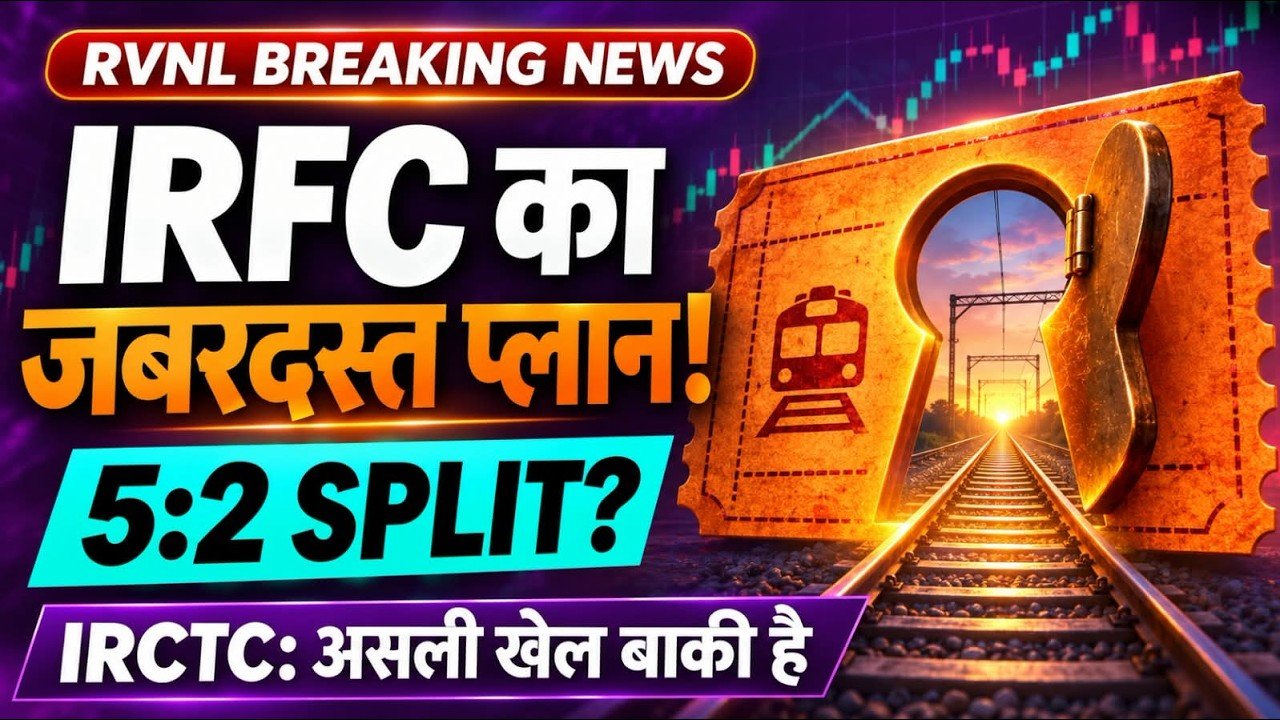
Vaibhav Global Share News: Company Announces a 5:2 Stock Split
Apart from railway stocks, the source video highlights a corporate action announced by Vaibhav Global Limited.
According to the transcript, the company informed the stock exchanges on 18 November 2026 about a proposed stock split.
The video describes the proposed change as a 5:2 split and states that the face value of each share would change from ₹5 to ₹2.
It also mentions 27 November 2026 as the effective date.
These details must be checked against the official exchange filing because the exact corporate-action terminology, entitlement ratio, record date, and effective date are important for shareholders.
What Is a Stock Split?
A stock split is a corporate action in which a company divides its existing shares into a larger number of shares by reducing the face value per share.
The total value of an investor’s holding does not automatically increase merely because the number of shares rises.
For example, if a company announces a split that changes the face value of its shares, the number of shares held by an investor may increase according to the approved ratio.
The market price is adjusted to reflect the change in the number of shares, subject to market movements.
A stock split does not, by itself, increase the company’s revenue, profit, cash balance, or business value.
Why Do Companies Announce Stock Splits?
Companies may consider stock splits for several reasons:
- To reduce the nominal price per share.
- To make the share denomination more accessible to a wider group of investors.
- To improve trading flexibility.
- To increase the number of shares available for trading.
- To improve market participation.
However, a stock split does not guarantee that the share price will rise.
The long-term value of the company continues to depend on its financial performance and business prospects.
Vaibhav Global Stock Split: What Should Existing Shareholders Check?
The transcript describes the face value change from ₹5 to ₹2 and refers to a 5:2 ratio.
Because the ratio and face-value details need to be reconciled with the official filing, investors should not calculate their post-split share entitlement solely from the transcript.
Before taking any action, shareholders should confirm:
- The approved stock-split ratio.
- The revised face value.
- The record date.
- The ex-date.
- The effective date.
- The eligibility conditions.
The video mentions 27 November 2026 as the effective date and suggests that investors should hold shares before that date to receive the benefit. However, the official record date and exchange trading timetable determine entitlement.
Investors should use the company’s formal announcement as the final reference.
Vaibhav Global Financial Performance: From Losses to Profit
Another positive development highlighted in the source video is Vaibhav Global’s reported improvement in profitability.
The transcript provides the following figures:
| Period | Profit or loss reported |
|---|---|
| March quarter | Loss of approximately ₹28 crore |
| June quarter | Loss of approximately ₹6 crore |
| Latest quarter discussed | Profit of approximately ₹6 crore |
The transcript does not clearly identify the financial year or complete reporting details for each figure. These numbers should therefore be verified against the company’s quarterly financial statements.
Nevertheless, the commentary highlights a movement from losses towards profitability.
Why Is a Return to Profit Important?
A company moving from losses to profits may attract investor attention because it can indicate improving business conditions.
However, investors should understand why the company returned to profitability.
Important questions include:
- Did revenue increase?
- Did operating costs decline?
- Did gross margins improve?
- Were there exceptional gains?
- Did foreign exchange movements affect the result?
- Is the improvement sustainable?
One profitable quarter does not necessarily establish a long-term turnaround.
For Vaibhav Global, investors should compare multiple quarters and examine operating cash flow, margins, and revenue trends.
Vaibhav Global FII Holding: Why Are Investors Monitoring Institutional Shareholding?
The source video also discusses changes in Vaibhav Global’s foreign institutional investor holding.
The transcript mentions the following figures:
| Period | FII holding reported in the video |
|---|---|
| December | 0% |
| March | Approximately 1% |
| June | Approximately 5% |
| September | Approximately 0.69% |
These figures appear to show changes in institutional ownership, but the sequence and reporting periods should be checked against the company’s official shareholding pattern.
There is also an important difference between an increase in institutional ownership and a sustained investment trend.
Does Higher FII Holding Mean a Stock Will Rise?
FII investment can influence investor sentiment and trading activity.
When foreign institutions increase their holdings, investors may interpret this as a sign of interest in the company’s prospects.
However, institutional buying does not guarantee future returns.
FII holdings can change because of portfolio rebalancing, valuation decisions, risk management, and broader market conditions.
Investors should examine the actual shareholding disclosures and compare them across several quarters.
For Vaibhav Global, the most important question is whether the company’s improving financial performance can continue and whether institutional interest remains stable.
RVNL vs IRFC vs IRCTC: Understanding the Differences Between Railway Stocks
Although RVNL, IRFC, and IRCTC are all associated with the Indian Railways ecosystem, their business models are different.
Understanding these differences is important because investors should not evaluate all railway stocks using the same financial indicators.
| Company | Main business area | Important factors to monitor |
|---|---|---|
| RVNL | Railway infrastructure and project execution | Order book, execution, margins, working capital |
| IRFC | Railway-related financing | AUM, borrowing costs, lending activity, asset quality |
| IRCTC | Catering, ticketing, tourism and travel services | Passenger activity, revenue growth, margins, business expansion |
Which Financial Indicators Matter for RVNL?
For RVNL, investors should pay particular attention to its order book, contract wins, execution progress, project margins, and cash collection.
A large order book is useful only when the company can execute projects efficiently and generate sustainable returns.
Which Financial Indicators Matter for IRFC?
For IRFC, the cost of borrowing and the return earned on financed assets are important.
A growing AUM may support expansion, but profitability also depends on funding costs, margins, credit exposure, and financial management.
Which Financial Indicators Matter for IRCTC?
For IRCTC, investors should examine passenger-related demand, online ticketing activity, catering revenue, tourism operations, and operating margins.
The company’s different business segments may respond differently to changes in passenger volumes and consumer spending.
What Should Investors Watch in Railway Stocks in 2026?
The recent correction in railway stocks has created uncertainty among shareholders. However, investors should avoid making decisions based only on short-term price movements.
Several factors deserve attention.
1. Government railway investment
Railway infrastructure spending, modernisation programmes, new trains, freight corridors, and electrification projects can influence the sector’s long-term opportunities.
2. New project orders
Companies such as RVNL depend on securing and executing infrastructure contracts. Investors should monitor new orders and the quality of the order pipeline.
3. Project execution
A strong order book must translate into completed work, revenue, and cash flow. Delays and cost overruns can affect profitability.
4. Financial performance
Quarterly revenue, operating profit, net profit, and cash flow help investors understand whether business growth is sustainable.
5. Institutional investment
FII and DII shareholding trends can provide information about institutional interest, but they should not be used as standalone buy or sell signals.
6. Valuation
Investors should compare share prices with earnings, cash flows, growth expectations, and the risks associated with each business.
7. Corporate announcements
Stock splits, joint ventures, new contracts, and changes in management or ownership should be verified through official disclosures.
Frequently Asked Questions (FAQs)
1. Why is RVNL share price falling despite its strong order book?
The source video highlights RVNL’s recent share price decline despite its reported project pipeline. Possible factors include profit booking after its earlier rally, valuation concerns, and changing investment preferences. However, the transcript does not establish one confirmed reason for the decline. Investors should examine the company’s latest financial results and official order-book disclosures.
2. What is the latest RVNL order book update?
The video mentions a substantial order book and an order-book-to-FY2026-revenue multiple of approximately 4.1 times. However, the order-book amount is garbled in the transcript. Investors should refer to RVNL’s official earnings presentation or conference-call transcript for the verified figure.
3. Why is IRCTC considered an important railway-sector stock?
IRCTC operates in several railway-related passenger service areas, including catering, online ticketing, tourism, and travel services. Its business model provides exposure to passenger activity and related services. Investors should still examine competition, regulation, revenue growth, margins, and valuation.
4. What is the IRCTC revenue growth mentioned in the video?
The source video reports year-on-year revenue growth of approximately 16.3%, taking revenue to around ₹13,331 million. It also mentions an EBITDA margin of approximately 30.6%. These figures should be checked against IRCTC’s official quarterly financial results.
5. What is IRFC’s AUM target?
The video mentions a long-term AUM ambition of approximately ₹5 lakh crore and reports AUM of around ₹4.69 lakh crore as of September. These figures should be verified against the company’s official disclosures. AUM growth does not automatically guarantee higher profitability.
6. Has Vaibhav Global announced a stock split?
According to the supplied transcript, Vaibhav Global announced a proposed stock split involving a change in face value from ₹5 to ₹2. The video describes it as a 5:2 split and mentions 27 November 2026 as the effective date. Investors should confirm the exact ratio, record date, and effective date through the official exchange filing.
7. Does a stock split increase an investor’s wealth?
No. A stock split increases the number of shares according to the approved ratio and adjusts the share price accordingly. It does not automatically increase the total market value of an investor’s holding. Future returns depend on business performance and market conditions.
8. Is it a good time to invest in railway stocks?
The supplied transcript does not provide enough verified information to establish whether any of these stocks is suitable for a particular investor. A decision should consider each company’s financial performance, valuation, business model, risk profile, and investment horizon. Investors should conduct independent research before investing.
Conclusion: Railway Stocks and Vaibhav Global Remain Important to Watch
The latest developments discussed in the video highlight different opportunities and risks across RVNL, IRFC, IRCTC, and Vaibhav Global.
RVNL’s project pipeline, joint ventures, Vande Bharat-related involvement, and infrastructure activities are important parts of its business outlook. However, the stock’s correction from its earlier highs shows why investors must consider valuation and execution rather than relying only on past price performance.
IRCTC’s reported revenue growth and operating margin have attracted attention, while its catering, ticketing, and tourism businesses remain central to its investment story. The brokerage view mentioned in the video is positive, but investors should examine the full report before relying on its recommendation.
IRFC’s financing business and reported AUM ambitions are also worth monitoring. Its long-term prospects will depend on asset growth, funding costs, financial performance, and risk management.
Meanwhile, Vaibhav Global’s proposed stock split and reported return to profitability have created additional investor interest. However, shareholders should verify the exact corporate-action terms and examine whether the improvement in earnings can continue.
The key takeaway is that a falling share price does not automatically make a stock attractive, just as a stock split or positive brokerage recommendation does not guarantee future returns. Investors should focus on verified financial information, business performance, corporate announcements, and valuation before making decisions.
This article is intended for educational and informational purposes only. It is not a buy, sell, or hold recommendation. Consult a qualified financial adviser and conduct independent research before investing in the stock market.
SEO Keywords: RVNL share latest news, RVNL share price today, RVNL Q2 results 2026, RVNL order book, RVNL future prospects, IRFC share latest news, IRFC share price, IRFC AUM target, IRCTC share latest news today, IRCTC Q2 results, IRCTC brokerage report, Vaibhav Global stock split, Vaibhav Global 5:2 split, railway stocks latest news 2026.
Suggested URL Slug: rvnl-irfc-irctc-share-latest-news-vaibhav-global-stock-split
Meta Description: RVNL, IRFC and IRCTC share latest news 2026: Explore railway stock updates, RVNL’s order book, IRCTC results, IRFC’s AUM target and Vaibhav Global’s proposed 5:2 stock split.